The best one for each case
| If your case is | The pick | What decides it |
|---|---|---|
| A Brazilian CNPJ on the contract | Mercado Bitcoin | CNPJ 18.213.434/0001-35 in its terms of use |
| Reserves checked by an independent third party | Kraken | procedure described as performed by an independent accountant |
| Verifying your own balance in the reserves | Binance | Record ID and Merkle leaf for self-verification |
| Knowing who receives your reais | Crypto.com | CNPJ 39.993.186/0001-62 on the deposit page |
How the eight compare
| Exchange | Named Brazilian entity | Published CNPJ | Reserves | Standing in Brazil |
|---|---|---|---|---|
| Mercado Bitcoin | Mercado Bitcoin Serviços Digitais Ltda. | yes, in its terms of use | none established | editorial only |
| Crypto.com | Foris DAX BR Ltda. and Foris GFS BR Instituição de Pagamento Ltda. | yes, on its deposit page | 1:1 asserted, report is old | editorial only |
| OKX | OKX Serviços Digitais Ltda. | cited as the Pix key | 1:1, periodic reports | editorial only |
| Coinbase | Coinbase Brasil Ltda. | — | none established | editorial only |
| Bitso | Nvio Brasil Bitso Instituição de Pagamento Ltda. | — | none established | editorial only |
| Bybit | Bybit Sociedade Prestadora de Serviços de Ativos Virtuais Ltda. | — | 1:1 programme published | editorial only |
| Binance | — | — | 1:1 with self-verification | editorial only |
| Kraken | — | — | independent accountant | editorial only |
Where there is a dash, the item was not verified as of 25 August 2026. Five of these exchanges have an individual trust review: Binance, Bitso, Bybit, Coinbase and OKX.
The answer nobody likes giving
Law 14.478 says virtual-asset service providers may only operate in the country subject to prior authorisation, and that the authorisation comes from a body or entity of the federal public administration. The 2023 decree names the body: the Banco Central do Brasil, with competence to regulate, authorise and supervise these companies.
In our data, none of the eight has that named authorisation confirmed against an official source. This is not a footnote, it is the headline: anyone searching for a "regulated exchange in Brazil" is looking for something we cannot yet confirm exists, with a name attached, among these eight.
That is why all eight stay classified as editorial only here, and why this page carries no commercial call to action.
Being subject to the rule is not holding the authorisation
These two get conflated constantly, including by the people selling. Mercado Bitcoin's terms of use are a good example of the honest version: they state that the group's securities brokerage and payment institution are subject to Banco Central regulation applicable to virtual-asset service providers, including BCB Resolutions 520 and 521.
Read it again: subject to the regulation. That is a statement that the rules apply to them, not that the Banco Central stamped an authorisation. The law itself anticipates that the federal body will set the cases and parameters under which authorisation may be granted through a simplified procedure — the process exists, and being inside its scope is not the same as having come out the other side with a yes.
When an exchange cites Resolution 520 in an advert, that is what it is actually saying.
Binance Global vs. 2 alternatives
A quick view of canonical data. Open the comparison for every source and condition.
 Binance Global
- Funding
- Not verified
- Taker fee
- 0.1%
- Status
- Editorial only
 Bitso
Bitso- Funding
- Pix + BRL
- Taker fee
- 0.4%
- Status
- Editorial only
 Coinbase
- Funding
- Pix + Bank transfer
- Taker fee
- 0.6%
- Status
- Editorial only
Who names a Brazilian company, and who publishes the number
Six of the eight name a Brazilian entity. Two publish the CNPJ in a document of their own, and that is the difference that matters on the day you need to complain about something.
Mercado Bitcoin's terms of use open by answering who the contracting party is: Mercado Bitcoin Serviços Digitais Ltda., registered under CNPJ 18.213.434/0001-35, based on Avenida Brigadeiro Faria Lima in São Paulo. Name, number and address in the first section of the contract you accept.
Crypto.com publishes CNPJ 39.993.186/0001-62 on its Brazilian real deposit page, identifying Foris GFS as the Brazilian account holder that receives the money. It is a less obvious place than a contract, but it is more concrete: it is the account your reais actually land in.
OKX's terms of service name OKX Serviços Digitais Ltda. as a Brazilian limited liability company, with a defined scope — users resident in Brazil who registered from 15 June 2023, plus migrated Brazilian users from before that date. In the canonical record, Coinbase, Bitso and Bybit also name Brazilian entities. Binance and Kraken name none.
Holding a CNPJ is not a licence. It is knowing who answers a complaint and in which forum, and that is worth money on the day something goes wrong.
Reserves: who publishes, and who brings in an outsider
Four of the eight publish some proof-of-reserves programme, and they are not equivalent.
Kraken describes its procedure as performed by an independent third-party accountant, to confirm that the custodian holds the assets it claims to hold for clients. Any client can check whether their own balance was included by comparing data against the Merkle root. It is the only one of the four whose published description puts an outside professional in the loop, which is why it wins this case.
Binance states that it holds user assets 1:1 including reserves, carries zero debt in its capital structure, and keeps an emergency fund for extreme cases. Its strength is self-verification: Binance publishes a Record ID and Merkle leaf so you can confirm your own balance made it into the liabilities report.
OKX states a 1:1 reserve of all account assets and periodic global reports, and labels the current one its 45th proof of reserves, covering 23.12 billion US dollars in primary assets. It is the programme with the most visible cadence.
Bybit publishes a 1:1 programme according to the canonical record. On the other side, Bitso, Coinbase and Mercado Bitcoin had no cryptographic proof of reserves established in our check, and Crypto.com asserts 1:1 backing but the independent report linked from its global page is old — do not treat it as a recent audit.
None of this is insurance. A proof of reserves is a snapshot of one moment and it does not cover liabilities outside its scope.
Reliability checklist
- Open your account terms and read the contracting entity's name and CNPJ.
- Look that CNPJ up in a public registry before you deposit.
- Read the recipient name on the Pix screen and check it against the contract.
- Where there is a proof of reserves, run the self-verification on your own balance instead of trusting the aggregate.
- Check the date of the latest reserves report, not just that one exists.
- Turn on two-factor authentication and restrict withdrawals to known addresses.
- Withdraw a small amount before concentrating funds.
- Decide how much of your money you are willing to leave with a single custodian.
Verify in 5 minutes (any exchange in this roundup)
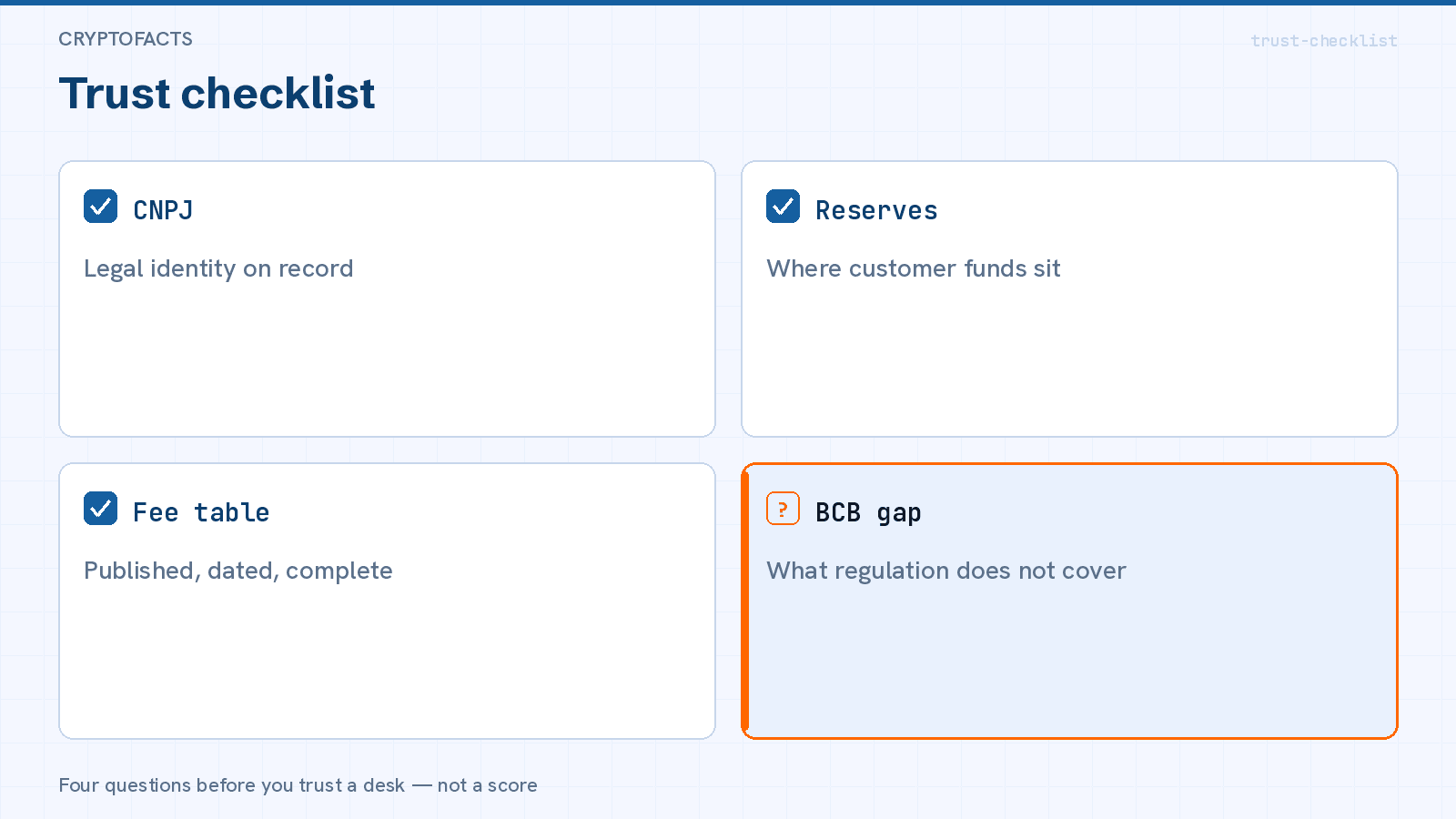
- Open the fee table — maker/taker you can screenshot.
- Name the contracting entity / CNPJ on the live terms for your product.
- Reserves — PoR or equivalent you can test from an account leaf when published.
- BCB / payment-institution status — authorised, payment institution, or gap — say which.
- Decision rule — pick on the checklist you can re-run next month, not on follower counts.
FAQ
Is any exchange licensed by the Banco Central? None of the eight has a named authorisation confirmed in our data. The law requires prior approval and the 2023 decree puts that approval with the Banco Central. Until an official source confirms a name, we treat all of them as editorial only.
Is a Brazilian exchange safer than a foreign one? Not automatically. What a Brazilian CNPJ delivers is an identifiable forum and an identifiable liable party. Mercado Bitcoin publishes its own in the contract, which is concrete, but it is neither a public guarantee nor an authorisation.
Does proof of reserves guarantee my money? No. It indicates coverage of custodied assets at the moment of the snapshot. Kraken's is the only one among those we checked whose published description involves an independent accountant; the others are self-asserted with cryptographic verification.
Is an exchange that cites BCB Resolution 520 regulated? It is saying the rule applies to it. That is not the same as having received Banco Central authorisation, and the gap between those two sentences is the whole point.
Do you earn a commission if I open an account? Not on this page. All eight are editorial only in our record.
Verdict
Trustworthiness has an answer once you say what you want to verify. Mercado Bitcoin for a Brazilian CNPJ on the contract, Kraken for reserves with an independent accountant, Binance for checking your own balance inside the proof of reserves, Crypto.com for knowing which Brazilian company receives your reais.
And the shared limit none of the four solves: without a named Banco Central authorisation confirmed, contractual and cryptographic transparency does not become regulatory approval. Compare the eight in the exchange list, see which exchange wins each use case or, if this is your first purchase, start with the beginners' guide.