At a glance
| What changes the decision | What we found |
|---|---|
| Entry-tier spot fee | 0.100% maker and 0.100% taker on the public table |
| Reserves | Proof-of-reserves programme with per-account verification |
| Identity checks | Full KYC, per the canonical CryptoFacts record |
| Brazil status | Editorial only: Central Bank authorisation not verified |
| Contracting entity | Varies by product and region; check your own account terms |
Reserves you can test yourself
Binance's proof-of-reserves page says the company holds funds covering user assets one to one, plus its own reserves. On its own that is a company statement.
The useful part is the second step. The same page explains that every user gets a Record ID and a Merkle leaf, and that those let you independently confirm your balance was included in the liabilities report. It is not a third-party audit and does not replace one, but it is a check you can run inside your own account in a few minutes.
Once your account is open, go to Wallet and find the verification section. If your balance is missing from a period's report, treat that as a reason to investigate before adding funds.
Fees: the number and the caveat
The published spot fee table starts at 0.100% maker and 0.100% taker for a regular user. Discounts follow 30-day volume or BNB balance, and Binance says VIP benefits apply across all its products.
Two practical warnings. First, that is the standard global rate before discounts, and our canonical record notes it is not automatically inherited by local Binance entities. Second, the trading percentage is only part of the cost — spread, currency conversion, and deposit or withdrawal charges all land in the final number. Compare the total shown on the confirmation screen, not the row in the table. The full cost breakdown lives in Binance fees in Brazil.
Binance Global vs. 2 alternatives
A quick view of canonical data. Open the comparison for every source and condition.
 Binance Global
- Funding
- Not verified
- Taker fee
- 0.1%
- Status
- Editorial only
 Bitso
Bitso- Funding
- Pix + BRL
- Taker fee
- 0.4%
- Status
- Editorial only
 Coinbase
- Funding
- Pix + Bank transfer
- Taker fee
- 0.6%
- Status
- Editorial only
The Brazilian rule, in one sentence
Law 14.478 says virtual-asset service providers may only operate in Brazil with prior authorisation, and a 2023 decree names the body that grants it: the Banco Central do Brasil, which regulates, authorises and supervises these firms.
That is why "this platform is huge" and "this platform is authorised in Brazil" are separate claims. As of 25 August 2026, we found no public source confirming that any Binance entity holds that authorisation or has an application under review. Until one does, the platform stays editorial in our records and carries no commercial call to action. The criteria we apply to every exchange are in what makes a crypto exchange trustworthy in Brazil.
Checklist before you fund an account
- Read your account terms to see which company you are actually contracting with.
- Confirm the fee tier applied to you inside the platform, not from third-party tables.
- Run the reserves check on your own account when the next period report is published.
- Test a small withdrawal before moving a meaningful amount.
- Turn on two-factor authentication and whitelist withdrawal addresses.
- Decide how much of your net worth you are willing to leave with one custodian.
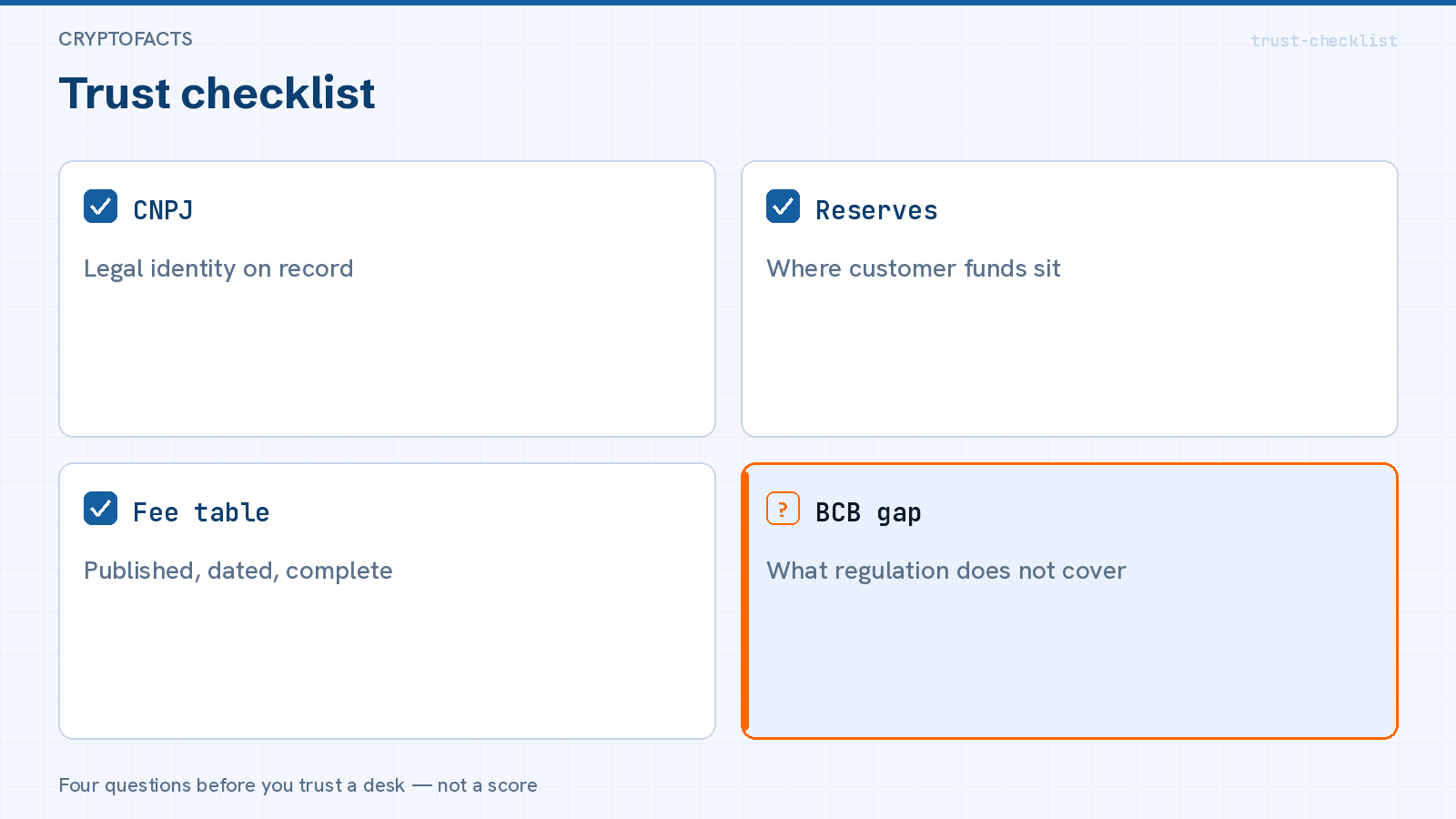
Verify in 5 minutes (do this yourself)
- Open fee table — spot maker/taker on Binance’s public fee page; note it is the global schedule before discounts.
- Reserves check — Wallet → proof-of-reserves / Record ID; confirm your balance leaf appears for a recent report.
- Entity name — read the contracting entity in your account terms (varies by product).
- BCB gap — as of our dated check, no named Binance entity in our record has confirmed Central Bank VASP authorisation in Brazil.
- Decision rule — use only if you accept a global venue with checkable fees/reserves and an unverified local stamp.
FAQ
Can Binance legally serve Brazilian users? Brazilians do use the platform. The open question is not access but formal authorisation: the law requires prior Central Bank approval, and we have not confirmed it was granted to a named Binance entity.
Does proof of reserves mean my money is guaranteed? No. It shows that, at snapshot time, custodied assets covered user balances. It is not insurance, not a public guarantee, and it does not cover operational or credit risk.
Will I really pay 0.1%? That is the starting point of the global table. Your real cost depends on your tier, the product, and what the platform quotes before you confirm the order.
Do you earn a commission if I sign up? Not from this page. Binance is editorial only in our records, so there is no referral link here.
Verdict
Binance is unusually transparent on two checkable fronts: a published fee schedule and reserves you can verify per account. What it does not offer, as far as we could confirm, is the local regulatory approval Brazilian law requires.
Treat it as a global exchange that Brazilians use, not as a financial service authorised in Brazil. If that trade-off works for you, compare the alternatives or see which exchange wins each use case before deciding where your balance sits.