The three routes at a glance
| Route | Cost | Speed | Tax consequence |
|---|---|---|---|
| Crypto card | From a claimed zero to about 2.2% per purchase, depending on the issuer; several do not publish the fee | Instant at the till | Every purchase is a disposal |
| Sell and withdraw via Pix | The exchange's trading fee plus any spread; Pix settles in seconds | Minutes from sale to money in your bank account | The sale is a disposal |
| Direct crypto payment | The blockchain's network fee; no intermediary | Depends on the network and its confirmation time | The payment is a disposal |
Route 1 — Crypto cards: how they work and what each issuer publishes
All six cards covered in Brazil today are, in practice, prepaid debit cards: you hold a crypto balance (or an account linked to an exchange) and the issuer converts it at the moment of purchase. The Binance Card launch announcement from Mastercard describes exactly that mechanism: real-time conversion into local currency at the moment of purchase.
One practical distinction matters more than most: the card's currency. The Binance Card and the Foxbit Card run in reais; the OKX Card, the Crypto.com Visa and RedotPay are US-dollar cards — on those, a purchase in reais also goes through foreign exchange, and that is where part of the cost hides.
| Card | Network | How reais get in | What the issuer publishes |
|---|---|---|---|
| Binance Card (Brazil) | Mastercard | Pix into your Binance account | Free issuance and no monthly fee; the Brazilian card's conversion and FX fees are not published |
| Bybit Card | Mastercard | Exchange balance | 0.9% conversion on top of the one-click sell rate; 1.5% FX on foreign-currency purchases; free issuance |
| Crypto.com Visa | Visa | BRL deposits via Pix, with no Crypto.com fee | US-dollar card; the 2% entry-tier cashback requires staking CRO |
| Foxbit Card | Mastercard | Foxbit balance (the exchange accepts Pix) | No annual fee; cashback of 0%, 0.5% or 1% by purchase size; conversion and FX fees not published |
| OKX Card | Mastercard | Pix converted into stablecoins instantly | The company states zero conversion fee and zero IOF; no Brazilian fee schedule is published |
| RedotPay | Visa | No direct Pix: you buy crypto on a local exchange and send it to RedotPay | 10 USDT virtual, 100 USDT physical, no annual fee; about 2.2% per purchase, per an independent review |
Some detail behind the table:
- Bybit has the most complete published schedule for Brazil: its official fee page lists 0.9% conversion (10 BRL minimum per conversion) and 1.5% FX on foreign-currency purchases, with free issuance for both the virtual and the physical card.
- OKX launched OKX Pay and the OKX Card with Brazil as its first market worldwide. According to Valor Econômico's coverage, Pix deposits convert into stablecoins with immediate settlement, and the OKX Brasil CEO states there is no conversion fee and no IOF. Those are company statements, not a published tariff table — confirm the numbers inside the app before your first purchase.
- Crypto.com charges no fee of its own on BRL deposits via Pix or TED; the 2% entry-tier cashback depends on keeping CRO staked.
- Foxbit publishes the Foxbit Card terms in Portuguese: cashback applies only to purchases paid in crypto and runs at 0% up to R$999.99, 0.5% from R$1,000 to R$2,999.99 and 1% above R$3,000.
- RedotPay does not accept Pix, boleto or TED. The route used in Brazil is buying crypto (usually USDT) on a local exchange and transferring it to your RedotPay account — one extra step and one extra network fee. The full walk-through, with costs and the tax rule, is in the RedotPay review.
On IOF, Brazil's tax on foreign-exchange transactions: dollar cards naturally raise the question. The only public position among the six is OKX's, which states it does not charge IOF on purchases; the other issuers publish no position on IOF. If IOF matters to your math, confirm it in the issuer's app before counting on an exemption.
The full side-by-side comparison of all six cards, with fees and rewards, lives in our crypto card comparison; the editorial take on which card wins on published numbers is in best crypto card in Brazil.
Route 2 — Sell on an exchange and withdraw via Pix
This is the most common route for larger amounts: sell the crypto on an exchange operating in Brazil and withdraw the reais via Pix. The advantages are control — you pick the moment and see the rate before confirming — and cost, which comes down to the exchange's trading fee plus any spread on instant-convert products. Fees vary widely between exchanges; our trading fee comparison shows the published schedules side by side.
The trade-off is friction: it takes two steps (sell, withdraw) instead of one tap at the till, and the money becomes reais in your bank account — if the point was to stay exposed to crypto, you have exited the position.
Route 3 — Pay directly in crypto where accepted
Some businesses and service providers in Brazil accept crypto directly, usually via a wallet and a QR code. There is no intermediary and no issuer fee: the cost is the network fee of the blockchain used, and speed depends on the network's confirmation time. It is the least available route — direct acceptance is still the exception in Brazilian retail — and the least standardized: the rate, the accepted coin and the receipt vary case by case. For tax purposes nothing changes: using crypto to pay for a good or service is a disposal, valued at the price of what you bought.
What the issuers do not publish
Three gaps show up on almost every card, and it is better to know them before the first purchase:
- Conversion spread. None of the six issuers publicly quantifies the gap between the rate it applies at conversion and the market rate. The published percentage fee is not necessarily the whole cost.
- Incomplete Brazilian schedules. Binance does not publish the Brazilian card's conversion and FX fees; Foxbit does not publish conversion, FX or issuance fees; OKX publishes no schedule for Brazil. Where a number does not exist publicly, this article does not invent one — confirm it inside your account.
- Cashback conditions. Binance's "up to 2%" and Crypto.com's "up to 8%" are program ceilings, not base rates. Foxbit's cashback only exists on crypto-funded purchases of R$1,000 and above.
Tax: every spend is a disposal
For Brazil's Receita Federal, using crypto to buy goods or services is treated as a disposal (alienação) — the sale value is the price of what you bought. That applies to the card, to selling on an exchange, and to paying directly.
What changes from person to person is the regime. In short: with custody at a Brazilian exchange, progressive rates of 15% to 22.5% apply to gains, with an exemption when total disposals in the month stay within R$35,000 and a monthly DARF payment when tax is due; with custody at a foreign platform, Law 14,754/2023 applies — a flat 15%, assessed annually, with no monthly exemption. We explain both regimes, the custody test and the collateral-card exception in our crypto card tax guide. This content is educational, not tax advice — confirm your situation with an accountant.
Checklist before you spend
- Pick the route by amount: card for everyday spending, sell-plus-Pix for larger sums.
- Open the fee table inside the issuer's app and confirm conversion, FX and issuance costs before the first purchase.
- If the card is dollar-denominated, remember purchases in reais go through foreign exchange — ask the issuer which rate applies.
- Record the date, the value in reais and the acquisition cost of every spend: you will need them for the tax calculation.
- Add up your disposals for the month (card spending counts) if your custody is domestic.
- Be skeptical of "zero fees" without a published table: a company statement is not a contractual tariff.
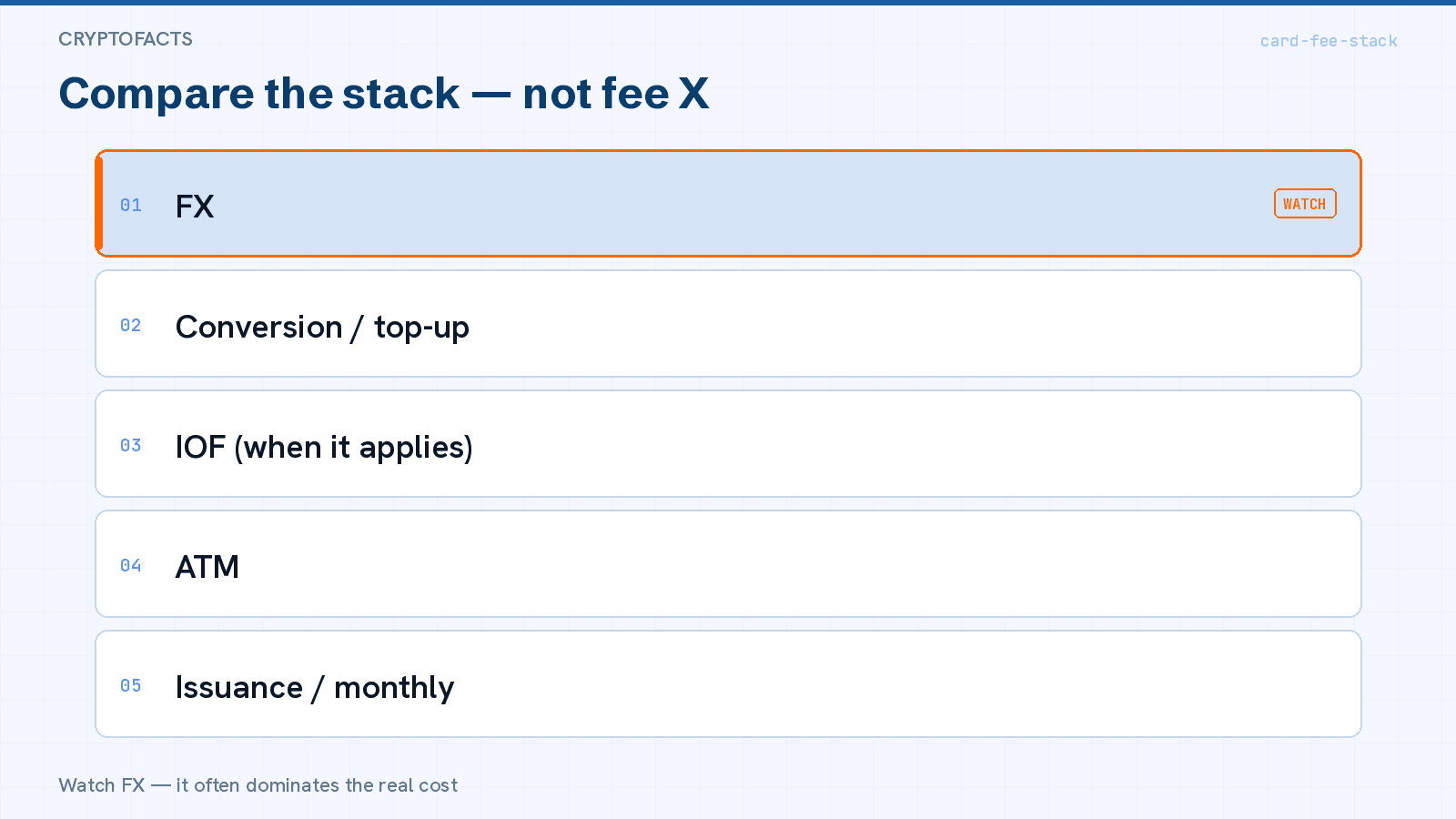
R$ worked example — spend R$500 abroad on a published card stack
Bybit Card (published): conversion 0.9%, FX 1.5% outside BRL, issuance/monthly R$0:
| Step | Published input | Approx. on R$500 |
|---|---|---|
| Conversion / top-up | 0.9% | ≈ R$4.50 |
| FX | 1.5% | ≈ R$7.50 |
| IOF | only if the receipt qualifies | not invented here |
| Subtotal before IOF | ≈ R$12 |
Compare that to sell → Pix cash-out (exchange trading + any withdraw line) for the same R$500 — the cheaper path depends on your rails, not the slogan.
FAQ
What is the cheapest way to spend crypto in Brazil? It depends on the amount and the card. Among published costs, Bybit charges 0.9% conversion (plus 1.5% FX when the purchase is in a foreign currency), RedotPay comes to about 2.2% per purchase, and OKX claims zero conversion cost — but publishes no table. For larger amounts, selling on a low-fee exchange and withdrawing via Pix usually costs less than a card's automatic conversion.
Do crypto cards pay IOF? Among the six issuers covered, only OKX publicly states that it charges no IOF on purchases. The others publish no position on IOF. Confirm in the issuer's app.
Does a small card purchase trigger tax? It creates a disposal, like any sale. Under the domestic regime there is an exemption when total disposals in the month stay within R$35,000; under the Law 14,754/2023 regime (foreign custody) there is no monthly exemption. The details are in our tax guide.
Do I need an exchange account to get a crypto card? In most cases, yes — Binance, Bybit, OKX, Crypto.com and Foxbit tie the card to an account on their platform. RedotPay is exchange-independent, but in practice you still need a local exchange to turn reais into crypto before loading the card.
Verdict
To spend crypto in Brazil without surprises, treat the three routes as different tools. The card wins on convenience — especially the BRL-denominated ones like Binance and Foxbit — but charges for it through conversion fees that are not always published. Selling and withdrawing via Pix wins on control and tends to cost less at larger amounts. Direct payment is niche, but it is the only route with no intermediary. In all three, the spend is a disposal: record every transaction and confirm your tax treatment with an accountant.