If your use case is different, the picture shifts: for spending in dollars with no published FX fee, look at the Crypto.com Visa (fee-free BRL deposits via Pix and, today, no foreign-transaction fee on the entry tier), and if you already hold stablecoins outside Brazil and just want a card that works at any Visa terminal, look at RedotPay — covered in depth in our RedotPay Brazil review.
All six are the same kind of card: prepaid debit
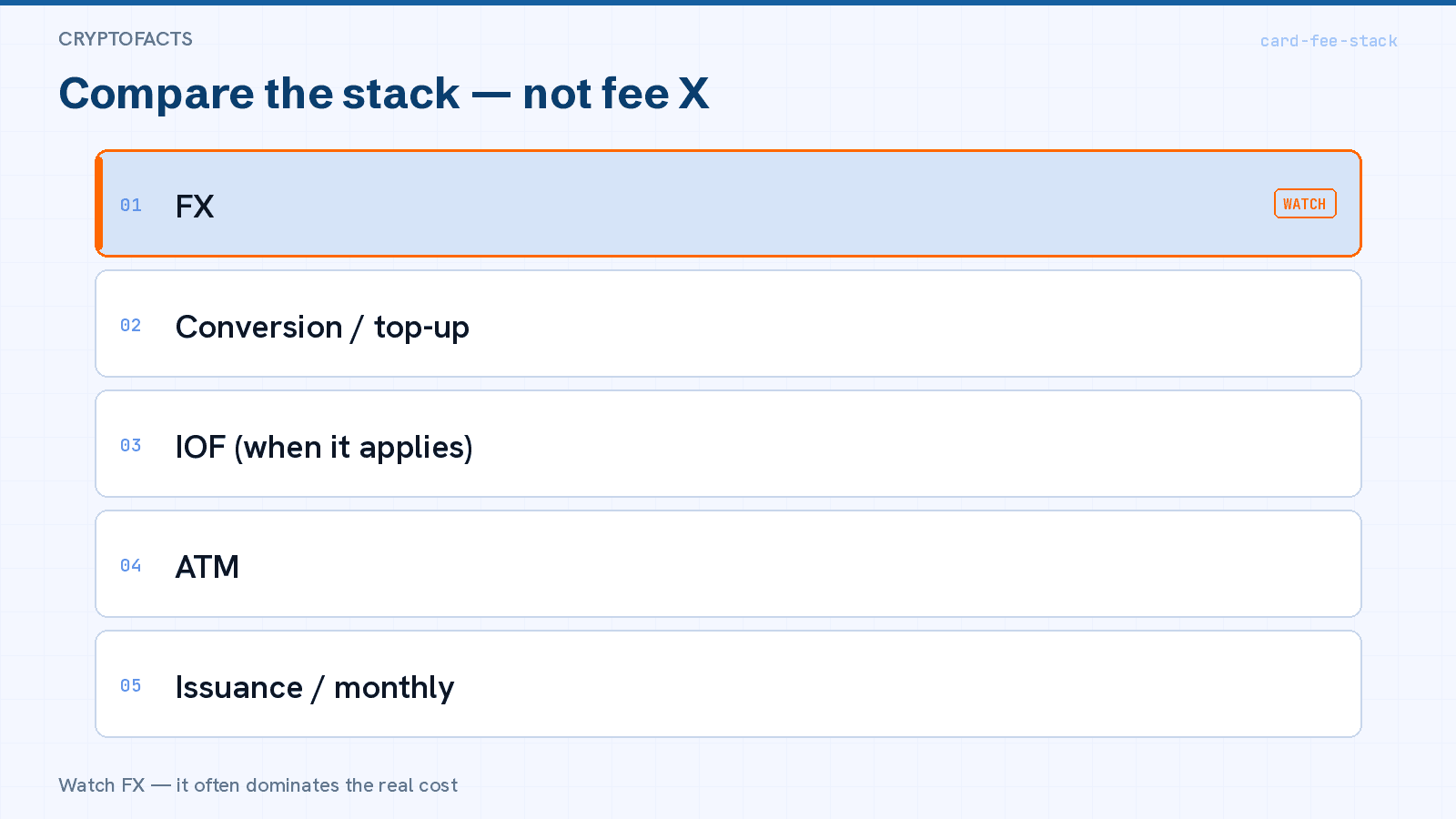
Crypto cards come in four families — true credit, prepaid debit, collateral-backed credit, and hybrids — and those families do not belong in one ranked list, because their costs work differently. All six cards on this page are prepaid debit cards: you load a balance (crypto or fiat) and purchases draw it down, with conversion happening at top-up or at the moment of payment. There is no statement, no credit line and no interest — the cost lives in conversion, FX and issuance fees.
Fee comparison: what each issuer publishes
| Card | Card currency | Conversion / top-up | FX fee | Monthly fee | Issuance |
|---|---|---|---|---|---|
| Bybit Card | BRL | 0.9% crypto conversion (min. R$10) | 1.5% outside BRL | R$0 | R$0 (virtual and physical) |
| Binance Card (BR) | BRL | not published for the Brazilian card | not published | R$0 | R$0 |
| Crypto.com Visa | USD | BRL deposits via Pix free; bank-card top-up 1% | 0% on Ruby today; from 1 Oct 2026, free up to US$500/month, then 2% | US$0 | physical: US$5.99 (Midnight) to US$29.99 (Ruby), with subscription or stake waivers |
| Foxbit Card | BRL | not published | not published | R$0 | not published |
| OKX Card | USD | Pix to stablecoin with no conversion fee (launch announcement) | 0% announced; no Brazil-specific table published | not published for Brazil | not published for Brazil |
| RedotPay | USD | crypto deposits free; 1% conversion at spend | 1.2% outside USD | US$0 | US$10 virtual / US$100 physical |
Three practical readings of that table:
- A BRL card pays no FX at home. Bybit, Binance and Foxbit settle in reais; a bakery purchase never touches the dollar. On the USD cards (Crypto.com, OKX, RedotPay), every purchase in reais is technically foreign-currency spend — on RedotPay that costs the 1.2% FX fee plus the 1% conversion fee, roughly 2.2% in total, per a Brazilian guide that walks through the product.
- Bybit is the only issuer that publishes an official Brazil fee schedule line by line: 0.9% conversion on top of its sell rate with a R$10 minimum, 1.5% FX, ATM free up to R$550/month then 2%, and a standard monthly spending limit of R$27,500 rising to R$550,000 at the top tier.
- An announced "no fees" is not a published schedule. OKX launched its card in Brazil in November 2025 — its first market worldwide, per Exame's coverage — and states that card purchases carry no IOF and no FX spread. But the only official fee table OKX publishes is the EEA one; there is no published Brazilian schedule, so confirm the numbers inside the app before relying on them.
All six cards also sit side by side in our card comparison tool.
Base cashback: what you get with no strings
We compare only the base rate — what you earn without hitting any tier — because the advertised maximums depend on conditions most users never meet.
- Crypto.com Visa: 2% in CRO on the Ruby tier, the entry tier of the Level Up program in Brazil — but it requires staked CRO (US$270 at the Brazilian launch promotion, normally US$500). Without the stake there is no cashback.
- Foxbit Card: 0% on a typical purchase. Foxbit's official page publishes the steps: 0% below R$1,000, 0.5% from R$1,000 to R$2,999.99, and 1% from R$3,000 — per purchase, and only when the purchase draws from a crypto balance. Purchases funded in reais earn nothing.
- RedotPay: 0%, with no rewards program at all.
- Binance Card (BR): launch communications advertise a maximum of 2%, capped at R$500 per month on crypto-funded spend, but the Brazilian program's base rate is not published in a verifiable source — confirm it in the app.
- Bybit Card and OKX Card: no base rate documented for the Brazilian program. Bybit runs periodic promotions; the OKX cashback table that exists is the European one and does not automatically apply to Brazil.
Pix and card currency
The funding rail matters as much as the fee. Binance Card (BR) and Foxbit Card are Brazilian cards denominated in reais, fed by the local ecosystem — Foxbit from your exchange balance, which tops up via Pix. Crypto.com takes fee-free BRL deposits via Pix and TED, processed by its Brazilian entity Foris GFS (CNPJ 39.993.186/0001-62), while the card itself is USD-denominated. OKX advertises Pix-to-stablecoin conversion with no fee inside OKX Pay. Bybit settles the card in reais but documents no direct Pix rail for the card — it is funded by selling your exchange balance. RedotPay has no Pix and no BRL deposit of any kind: the route is buying USDT on a Brazilian exchange and sending it to the app, which we walk through in the full review. If you do not have an exchange account yet, start with our first crypto purchase guide. And if the earlier question — card, sell-and-withdraw via Pix, or direct payment — is still open, our guide to spending crypto in Brazil compares the three routes.
Digital wallets and cash
All six work with Google Pay, and Apple Pay is listed for the Brazilian programs — with one nuance for recently issued RedotPay cards, covered in the RedotPay review. For cash: Bybit gives R$550/month free at ATMs and charges 2% after; Crypto.com charges 2% above its monthly free ATM allowance; RedotPay charges 2% (up to US$10,000/month) plus the 1.2% FX fee outside the dollar; the OKX card is virtual-only and cannot withdraw cash.
What the issuers do not publish
An honest comparison says where the numbers are missing. Binance does not publish the conversion or FX fee for the Pomelo-issued Brazilian card — the Global Program figures do not carry over. Foxbit does not publish FX, issuance or top-up fees. OKX publishes no Brazilian fee or cashback table. Bybit documents no base cashback for Brazil. Where no number exists in a verifiable public source, this page does not invent one: confirm inside the app before your first top-up.
Two context warnings that are worth money: Bybit has announced the migration of Brazilian users to a local entity, with mandatory additional verification to keep card access; and one Portuguese-language third-party guide still describes the OKX Card as exclusive to Europe and Singapore, contradicting the press coverage of the Brazilian launch. Confirm availability inside the app before ordering either card.
What about the Nexo Card?
Readers ask about the Nexo Card, and the answer fits in one line: Nexo's official Portuguese page states the card is available only to citizens and residents of selected European countries (the EEA and the United Kingdom) — Brazil residents are not eligible.
Tax: spending crypto with a card is selling crypto
On all six cards, paying for a purchase from a crypto balance converts that balance — and a conversion is a disposal for Brazilian income tax, the same as a sale. The regime depends on where the crypto is custodied: balances on Brazilian exchanges follow the domestic regime (15% to 22.5% progressive, exempt when total monthly disposals stay within R$35,000), while balances custodied with foreign providers fall under Lei 14.754/2023 (a flat 15% per year, with no monthly exemption). Each issuer on this page lands in one of those frames depending on its corporate structure. Both regimes, the custody test and the collateral-card exception are covered in our crypto card tax guide; before making a crypto card your main payment method, confirm how your case is classified with an accountant.
R$ worked example — domestic vs foreign on a BRL-settling card
Bybit Card (published): issuance R$0, monthly R$0, conversion 0.9%, FX 1.5% outside BRL, ATM free to R$550/month then 2%.
| Scenario | Stack that bites | Approx. on R$500 |
|---|---|---|
| Padaria in BRL | conversion 0.9% only (no FX on domestic BRL settle) | ≈ R$4.50 |
| Foreign online spend | conversion 0.9% + FX 1.5% (+ IOF if receipt shows it) | ≈ R$12 before IOF |
| ATM R$300 (inside free tier) | R$0 ATM fee on published free tier | R$0 ATM + any convert if funding from crypto |
Pick on the stack for your use, not the door slogan.
FAQ
What is the best crypto card in Brazil? By published numbers, the Bybit Card: R$0 issuance, 0.9% conversion, a card denominated in reais (no FX on domestic purchases), free ATM withdrawals up to R$550/month, and the only official Brazil-specific fee schedule. For cashback without staking, no published base rate today beats Foxbit's steps from R$1,000 per purchase.
Is there a crypto card with Pix? Yes. Binance Card (BR) and Foxbit Card run in reais inside the local ecosystem; Crypto.com and OKX take BRL in via Pix at the app level (the card itself is in dollars). RedotPay takes no Pix — the route is USDT through a Brazilian exchange.
Do crypto cards charge an annual fee? None of the six lists a monthly or annual fee, with one caveat: OKX publishes no fee schedule for Brazil, and physical issuance can cost — US$10/US$100 at RedotPay, and US$5.99 to US$29.99 at Crypto.com depending on the plan, with waivers.
Does paying with a crypto card trigger tax? Yes: every purchase that converts crypto is a disposal in the eyes of Brazil's tax authority, even a small one. The regime (progressive domestic or the flat 15% of Lei 14.754/2023) depends on where the crypto is custodied. Confirm with an accountant.
Verdict
The Bybit Card wins the 2026 comparison because it is the only crypto card in Brazil that publishes its own country-specific fee schedule — and the published numbers are good: R$0 issuance, 0.9% conversion, the real as card currency. The Crypto.com Visa is the pick for dollar spending if you accept the staking mechanic behind its 2% CRO rate; Foxbit is the Brazil-native card for people already on that exchange; and RedotPay solves a different problem — spending stablecoins that already live outside Brazil. Wherever an issuer publishes no number, the right move is to confirm it in the app before loading a balance.