Fees and terms are as captured on August 25, 2026, alongside our exchange data. Everything can change; confirm inside your own account.
Side by side
| Fact that changes the decision | Binance | Coinbase |
|---|---|---|
| Published taker fee | 0.10% | 0.60% |
| Published maker fee | 0.10% | 0.40% |
| Scope of that schedule | global spot, before discounts | Coinbase Exchange, entry tier |
| Taker cost on BRL 1,000 | BRL 1.00 | BRL 6.00 |
| Pix documented by the provider | not on record | yes, BRL 1 minimum |
| Named Brazilian entity | not on record | Coinbase Brasil Ltda |
| Published proof of reserves | yes | not on record |
| Brazil market status | editorial only | editorial only |
Binance Global vs. 2 alternatives
A quick view of canonical data. Open the comparison for every source and condition.
 Binance Global
- Funding
- Not verified
- Taker fee
- 0.1%
- Status
- Editorial only
 Bitso
Bitso- Funding
- Pix + BRL
- Taker fee
- 0.4%
- Status
- Editorial only
 Coinbase
- Funding
- Pix + Bank transfer
- Taker fee
- 0.6%
- Status
- Editorial only
What 0.10% and 0.60% cost on a BRL 1,000 buy
Binance's fee schedule puts an ordinary account at level 0, the Regular User tier, with a maker and taker commission of 0.001 — that is 0.10%. Coinbase Exchange's fee documentation uses a maker-taker model and says an order placed at the market price and filled immediately is a taker order paying between 0.04% and 0.60%. A new account sits at the expensive end of that range.
On a BRL 1,000 taker buy that is BRL 1.00 at Binance and BRL 6.00 at Coinbase. Repeat it monthly and the gap clears BRL 60 a year, scaling with whatever you actually trade. The full bill for each is in what Binance charges and what Coinbase charges.
Compare the final price on the confirmation screen, not just the percentage. Spread and currency conversion sit outside the fee table and still come out of your money.
Neither of those numbers is a Brazilian price
This is where most comparisons go wrong. The Binance figure is the standard global spot rate before discounts and is not automatically inherited by local Binance entities. The Coinbase figure is specific to the Coinbase Exchange product and moves with tier and product.
So you are comparing two global schedules, not two quotes in reais for your account. The order of magnitude still holds — 0.10% is six times smaller than 0.60% — but check the rate shown inside your own account before you commit.
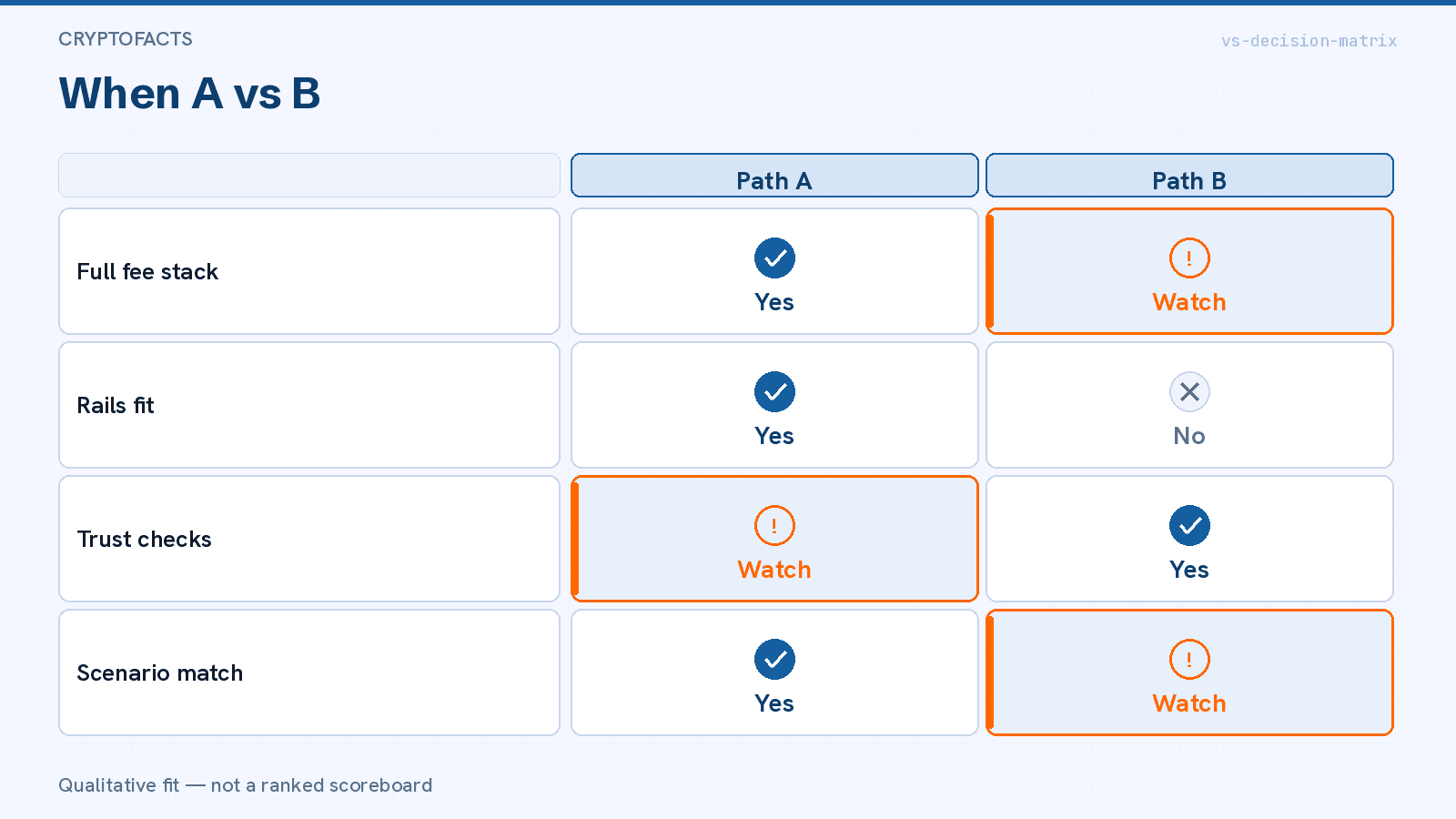
Getting reais in: only one side documents it
Coinbase's payment-method table for Latin America lists Pix and bank transfer for Brazilian customers, with a minimum deposit of one real and settlement described as instant. Our data for Coinbase carries BRL and Pix.
On the Binance side, the sources behind this comparison describe no route in reais, and we did not verify how a Brazilian customer funds a Binance account with reais. Confirm it in the app before you rely on that step — our dedicated review, what Binance charges, covers what Binance publishes about BRL deposits and withdrawals.
Which company you actually contract with
Coinbase's Brazil page states that on 1 September 2023 the company established Coinbase Brasil Ltda to serve all users residing in Brazil, and that the entity is based in Brazil with a valid CNPJ.
What we have on Binance describes contracting entities that vary by region and names no Brazilian one. If you want to know in advance who answers a dispute, that is a concrete point for Coinbase.
Keep two things apart, though. A CNPJ is a company registration, not a Banco Central authorisation. Both providers stay editorial only in our data because neither has a named authorisation confirmed against an official source under the current transition rules.
Reserves and transparency
Binance's proof-of-reserves page says users can verify that all Binance account balances are fully backed 1:1, and that the company built and implemented a Merkle Tree so each user can confirm their own balance sits inside the aggregate. In our data Coinbase carries no user-verifiable proof of reserves; its transparency comes from disclosed licences and public-company reporting.
If cryptographic proof of reserves is on your list, that point goes to Binance.
Checklist before you open an account
- Confirm the fee shown for your own tier inside the account, not the public table.
- Check that the reais funding method appears for your region, and what the limits are.
- Read the contracting entity name and CNPJ in your account terms.
- Quote the same order on both platforms at the same moment and compare the final price.
- Read the withdrawal rules before you deposit, not after.
- Decide how much of your money you are willing to leave with one custodian.
FAQ
Is Binance cheaper than Coinbase? On the published schedule, yes: 0.10% against up to 0.60% on taker orders. But both are global schedules and real cost includes spread and conversion. Without quoting the same order on both at the same moment, that is a paper advantage rather than a measurement.
Can I fund both with Pix? Coinbase documents Pix for Brazilian customers with a BRL 1 minimum. For Binance, the sources behind this comparison describe no such route — confirm it in the app.
Is either one licensed by the Banco Central? In our data neither has a named authorisation confirmed under the transition rules. Both remain classified as editorial only.
Which one if I am starting from zero? For the shortest path from reais to crypto, Coinbase documents the route and asks for a BRL 1 minimum. If you already trade and cost per order is the deciding factor, Binance publishes the cheaper schedule.
Verdict
These are different answers to different priorities. Binance if you are optimising cost per order; Coinbase if you want a documented reais route and a named Brazilian company on the contract.
Neither has a named Banco Central authorisation confirmed in our data, which is why both stay editorial only here with no referral link. Compare the final cost of both in the exchange list and see the full ranking in which crypto exchange charges the lowest fees in Brazil.