RedotPay does serve Brazil residents: the official physical-card delivery restriction list, published in Portuguese, names more than forty regions where delivery is unavailable — the United States, Russia, India and Turkey among them — and Brazil appears on none of the product's exclusion lists, which span 42 markets in total.
How it works for a Brazilian: Pix does not reach it
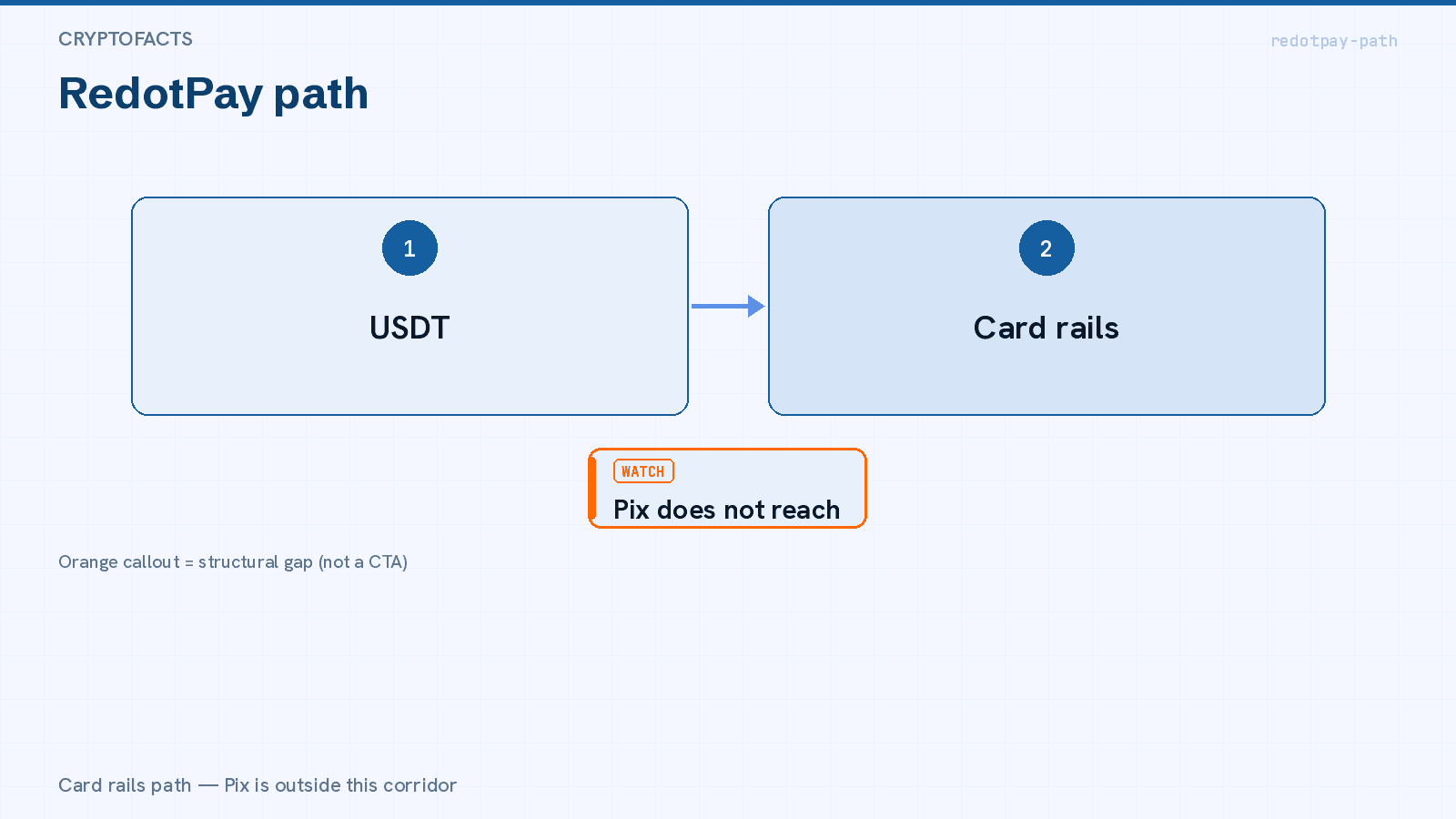
This is the fact that defines the product in Brazil: RedotPay accepts no direct deposits via Pix, TED, boleto or PicPay. There is no BRL rail at all. Starting from reais takes three steps:
- Buy USDT on a Brazilian exchange, funding it via Pix. If you do not have an exchange account yet, our first crypto purchase guide walks through it with costs, and the Pix deposit guide covers getting reais onto the exchange.
- Send the USDT to your address in the RedotPay app. Crypto deposits into RedotPay are free — you only pay the blockchain network fee, and TRC20 is the cheapest of the supported networks.
- Spend with the card. Purchases draw down the dollar balance; conversion happens at the moment of payment.
That detour through an exchange has two practical consequences. The first is extra cost and friction on the way in: the exchange's trading fee and the network fee come before any card fee. The second is that your balance now lives on a foreign platform — which changes the tax treatment, covered below. To weigh this route against the other two ways of spending crypto — selling with a Pix withdrawal and paying directly — see our guide to spending crypto in Brazil.
The full fee table (in US dollars)
RedotPay publishes no BRL schedule; every fee belongs to the USD card, and that is how they should be read. The numbers below were verified by independent reviews against the official help center in July 2026:
| Item | Cost |
|---|---|
| Virtual card issuance | US$10, one-time, non-refundable |
| Physical card issuance | US$100, one-time, non-refundable |
| Monthly / annual fee | US$0 |
| Crypto top-up (on-chain) | free (network fee only) |
| Top-up via Binance Pay | 1% |
| Top-up with a bank card or PayPal | 3%, minimum US$1 |
| Crypto conversion at spend | 1% |
| FX fee outside USD | 1.2% |
| Purchase in reais (typical total) | about 2.2% |
| ATM withdrawal (USD card) | 2% up to US$10,000/month; 3% above — plus the 1.2% FX fee outside USD |
| Selected merchants (ad platforms, games) | 1.5%, minimum US$0.50, 3 waivers per month |
The reading that matters for a Brazilian: because the card runs in dollars, every purchase in reais is foreign-currency spend. The Brazilian guide that walks through the product lands on the same totals — a standard purchase cost of 2.2% and ATM withdrawals at 4.2%. On a R$1,000 purchase that is about R$22 in fees before the merchant sees the money. The BRL-denominated cards in our crypto card comparison carry no such cost on domestic purchases; all six cards covered in Brazil sit side by side in the card comparison tool.
What RedotPay does not publish
- The card's issuing bank. No issuer or BIN sponsor is disclosed, and no deposit insurance or data-security certification is published. The balance is custodial: the platform controls the keys, not you.
- Standard spending limits. Limits are set per card inside the app; what is documented is a security-triggered cap of US$1,000 per transaction and per day for 24 hours.
- A Brazil-specific schedule. There is none; the USD numbers above are the schedule.
One trust note: independent reviews describe the custody arrangement differently, so this page does not name a custody partner — treat the balance as platform-custodied and size it accordingly. On digital wallets: Google Pay works in eligible regions; Apple Pay was paused for cards issued after 22 August 2025 and is being restored through a free card upgrade rolling out since 15 January 2026 — if you order today, you may need to request that upgrade in the app.
Tax: foreign custody changes the rule
Spending crypto with the card is a disposal for Brazilian income tax — every purchase counts as a sale of the asset. And because RedotPay is a foreign provider, a balance held there falls under Brazil's offshore-crypto rule: Lei 14.754/2023 applies a flat 15% per year on gains, assessed in the annual return, without the R$35,000 monthly exemption that exists under the domestic regime. The rate change floated in MP 1.303 did not take effect. For someone holding only dollar stablecoins, the taxable gain is usually the currency and price movement between buying and spending — small per transaction, but laborious to compute, because the app exports no tax reports. Both regimes — domestic and foreign — are explained in our crypto card tax guide. Before making the card a recurring payment method, confirm your classification and reporting routine with an accountant.
Who it fits — and who it does not
It fits:
- people who already earn or hold USDT/USDC outside Brazil (a freelancer with foreign clients, for example) and want to spend directly at the terminal, without repatriating through bank FX;
- travellers who want a dollar card accepted wherever Visa works, with ATM access abroad;
- anyone who wants a cheap test: the US$10 virtual card covers online purchases and digital wallets.
It does not fit:
- people starting from reais: the exchange → USDT → app detour makes every top-up slower and more expensive than a card with a local rail — in the comparison, Bybit and the BRL-denominated Brazilian cards cost less for domestic spending;
- anyone deciding on cashback: RedotPay's reward rate is 0%, with no points program;
- anyone unwilling to leave a meaningful balance in third-party custody with no disclosed issuer or insurance.
FAQ
Does RedotPay work in Brazil? Yes. Brazil appears neither on the unsupported-countries list (42 markets, including the United States) nor on the physical-card delivery restriction list, which is published in Portuguese in the official help center.
Can I fund RedotPay with Pix? Not directly. RedotPay accepts no Pix, TED, boleto or PicPay. The route is buying USDT on a Brazilian exchange via Pix and sending the crypto to your app address — TRC20 usually carries the lowest network fee.
How much does RedotPay cost in Brazil? US$10 (virtual) or US$100 (physical) one-time issuance, no monthly fee. In use: 1% conversion plus 1.2% FX on non-dollar purchases — about 2.2% on a purchase in reais — and 2% to 3% on ATM withdrawals.
Does RedotPay pay cashback? No. The reward rate is 0%, with no cashback tier and no subscription that unlocks one.
Do I have to declare a RedotPay balance? Crypto custodied with a foreign provider falls under Lei 14.754/2023 (a flat 15% per year on gains, with no R$35,000 monthly exemption). The app produces no tax reports, so keep your own records and confirm with an accountant.
Verdict
RedotPay is a well-defined niche card: prepaid, dollar-denominated, with published and verifiable fees, no monthly cost and no cashback, solving one problem — spending stablecoins that already live outside Brazil. For that reader, 2.2% per purchase in reais is the price of skipping bank FX, and the US$10 virtual card is a cheap test. For someone starting from reais who wants an everyday crypto card, the math does not close: BRL cards with local rails and cheaper conversion exist in our comparison. Either way, the balance is custodial with a foreign provider that discloses no issuer — size what you leave there, and remember that the offshore tax rule (15% per year, no monthly exemption) follows the balance.