At a glance
| What changes the decision | What we found |
|---|---|
| Who holds your reais | Nvio Brasil Bitso Instituicao de Pagamento Ltda., regulated by the Central Bank |
| Pix | Free of charge for deposits and withdrawals on the published table |
| Real-denominated trading fee | From 0.200% maker and 0.400% taker on the entry tier |
| Identity checks | Full KYC, per the canonical CryptoFacts record |
| Brazil status | Editorial only: virtual-asset provider authorisation not verified |
Who actually holds your reais
Bitso's Brazilian security page states that its real-denominated operations are carried out by Nvio Brasil Bitso Instituicao de Pagamento Ltda., a payment institution regulated by the Banco Central do Brasil.
That is the sharpest difference between Bitso and the global exchanges we reviewed. A supervised Brazilian entity handles the local-currency side, rather than a contract signed offshore.
Keep the caveat in view: a payment institution licence and virtual-asset service authorisation are different permissions under different regimes. One does not imply the other.
Pix: free in, free out on the exchange side
On the deposits and withdrawals table, the Brazilian real section lists Pix as free of charge in both directions.
That matters more than it looks. On a small account, the cost of moving money often weighs as much as the cost of trading. If you deposit a few hundred reais a month, a fixed deposit charge eats your return faster than a few hundredths of a percent on the order.
Bitso vs. 2 alternatives
A quick view of canonical data. Open the comparison for every source and condition.
 Bitso
Bitso- Funding
- Pix + BRL
- Taker fee
- 0.4%
- Status
- Editorial only
 Coinbase
- Funding
- Pix + Bank transfer
- Taker fee
- 0.6%
- Status
- Editorial only
 Kraken
- Funding
- Pix + BRL
- Taker fee
- 0.8%
- Status
- Editorial only
Trading fees: where the maths tightens
Bitso's fee table has a dedicated section for real-denominated markets, tiered by 30-day volume on a maker-taker model. The entry tier starts at 0.200% maker and 0.400% taker.
Set that against the global exchanges, which publish something close to 0.100% on their entry tiers, and the gap is clear: on the taker side, the cost per order can run around four times higher.
Put in money terms, a market order of 1,000 reais costs roughly 4 reais in fees on the entry tier. Using limit orders that rest on the book moves you to the maker side and cuts that. The same page notes that the published schedule covers services offered by Bitso International on the exchange platform.
What we did not verify
One difference readers should know about: our canonical provider record establishes no public proof of reserves for Bitso, while the company's Brazilian page describes regularly published cryptographic proof that user funds are fully accounted for. Treat the programme as claimed by Bitso and not yet confirmed by our provider verification.
We also did not verify, as of 25 August 2026, Bitso's authorisation as a virtual-asset service provider. Law 14.478 requires prior approval from a federal body, and a 2023 decree placed that competence with the Central Bank. Being a regulated payment institution does not satisfy that requirement. The criteria we apply to every exchange are in what makes a crypto exchange trustworthy in Brazil.
Checklist before you fund an account
- Confirm the recipient's name and tax ID on the Pix screen before transferring.
- Check which fee tier applies to your account on the real-denominated table.
- Prefer limit orders if per-trade cost matters to you.
- Make a small Pix withdrawal to measure the real settlement time.
- Turn on two-factor authentication and enable the withdrawal lock.
- Read the terms to see which entity is responsible for each part of the service.
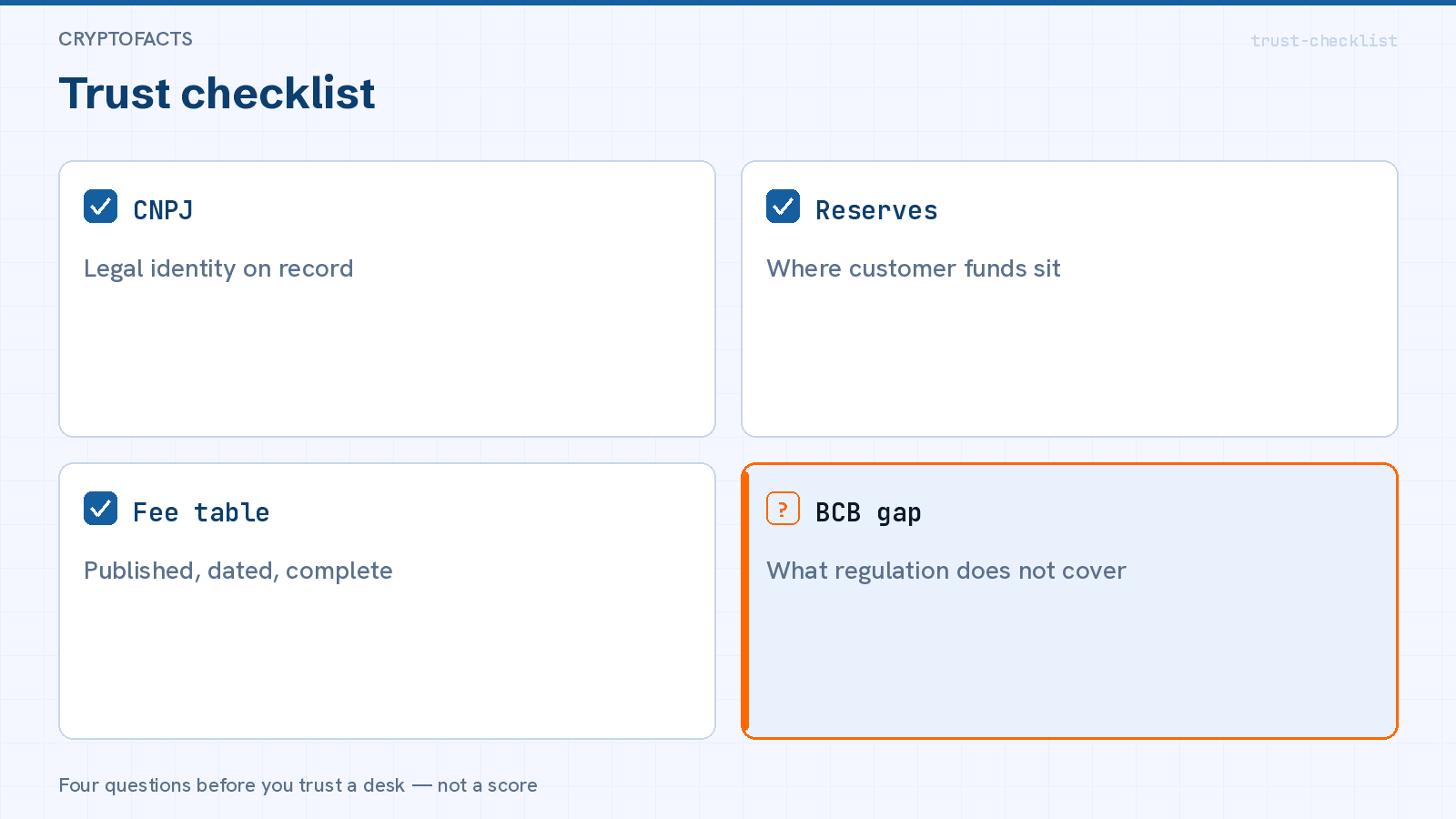
Verify in 5 minutes (do this yourself)
- Entity — confirm reais custody naming (e.g. Nvio Brasil Bitso Instituição de Pagamento Ltda. in our dated check).
- BCB angle — Bitso’s Brazil path is the most payment-institution-native in our set; still read the live terms for your product.
- Fee table — open published maker/taker (entry cited: 0.200% / 0.400%).
- Reserves — check what Bitso publishes for PoR vs what the Brazilian page claims.
- Decision rule — use only if the named regulated path and fee table match what you need.
FAQ
Is Bitso regulated by the Central Bank? The entity running its real-denominated operations is a payment institution regulated by the Central Bank. That is not the same as authorisation to provide virtual-asset services, which we did not verify.
Is Pix really free? The published table lists Pix deposits and withdrawals with no exchange charge. Confirm on the confirmation screen, because tables change.
Why is the real-denominated fee higher? Bitso publishes a separate schedule per currency. In the real market, the entry tier costs more than competitors' global tables.
Do you earn a commission if I sign up? Not from this page. Bitso is editorial only in our records.
Verdict
If you move in and out of reais often, Bitso solves the part that usually causes friction: local currency sits with a payment institution supervised by the Central Bank, and Pix carries no exchange charge. That is also why it is our pick for a first purchase by beginners.
You pay for that in trading fees, which on the entry real tier run well above the global exchanges. And the specific virtual-asset authorisation remains unconfirmed. Compare the alternatives against how much you trade and how often you move money.