| Score input | Published example (profile) |
|---|---|
| Spot maker/taker | Binance Global 0.1%/0.1%; Bybit Global 0.1%/0.1%; OKX Global 0.08%/0.1% |
| Fee basis (what the tier means) | Bybit: Non-VIP; OKX: regular-user; Binance: standard global spot fee before discounts |
| Brazil market status | editorial only when named BCB authorisation is unverified |
| Out of score | Follower counts, influencer clips, migration rumours |
What enters the score
The desk compares what the profile stores with a capture date and fee basis note. For the global exchanges in this article, that includes:
- Published spot fees. Binance Global records 0.1% maker / 0.1% taker with fee basis note “standard global spot fee before discounts”. Bybit Global records 0.1%/0.1% as Non-VIP spot. OKX Global records 0.08% maker / 0.1% taker on the regular-user global framework.
- Market availability.
Brazil market statusdecides whether CryptoFacts can compare editorially and whether a monetized CTA may light up. On the three globals above — and on Mercado Bitcoin — the verified BR status in this capture iseditorial only: BCB transition rules apply, but named-entity authorisation was not verified; CTA stays off. - Rails when present. Mercado Bitcoin lists Pix and bank transfer in
paymentMethods. That informs local friction reading; we do not invent the same rail on globals when the profile lists none.
That is source-backed comparison: a reader can reopen the profile and check the same field.
What stays out
Follower counts, “everyone migrated”, group screenshots, and app-store ranks do not replace maker fee / taker fee / market status. They may suggest a research question (“why did volume move?”). The answer still needs a dated field.
Also out:
- secret UI weight equations the desk has not documented;
- third-party fee tables that were never ingested (especially Mercado Bitcoin fees — the profile stores null maker/taker and fee basis note says no stable like-for-like entry tier was verified);
- authorisation rumours treated as if they were verified
market status.
Example with published fields
Side-by-side, only what the profile carries:
| Provider | Maker / taker | Fee basis (what the tier means) | Brazil market status |
|---|---|---|---|
| Binance Global | 0.1% / 0.1% | standard global spot before discounts | editorial only |
| Bybit Global | 0.1% / 0.1% | Non-VIP spot | editorial only |
| OKX Global | 0.08% / 0.1% | regular-user global framework | editorial only |
| Mercado Bitcoin | null / null | no stable like-for-like entry tier verified | editorial only |
OKX looks “cheaper” on maker (0.08% vs 0.1%). That is a profile fact — and it still does not finish the decision alone: BR status is editorial only on all four, Pix appears on Mercado Bitcoin’s profile and not on the three globals in this capture, and a typical Brazilian total cost also includes deposit, withdrawal, and (if a card is involved) an FX/conversion stack outside this spot table.
Binance Global vs. 2 alternatives
A quick view of canonical data. Open the comparison for every source and condition.
 Binance Global
- Funding
- Not verified
- Taker fee
- 0.1%
- Status
- Editorial only
 Bitso
Bitso- Funding
- Pix + BRL
- Taker fee
- 0.4%
- Status
- Editorial only
 Coinbase
- Funding
- Pix + Bank transfer
- Taker fee
- 0.6%
- Status
- Editorial only
Method vs vibes: desk checklist
- Open the provider’s
CryptoFacts provider profilesrow and readmaker fee,taker fee,fee basis note. - Read
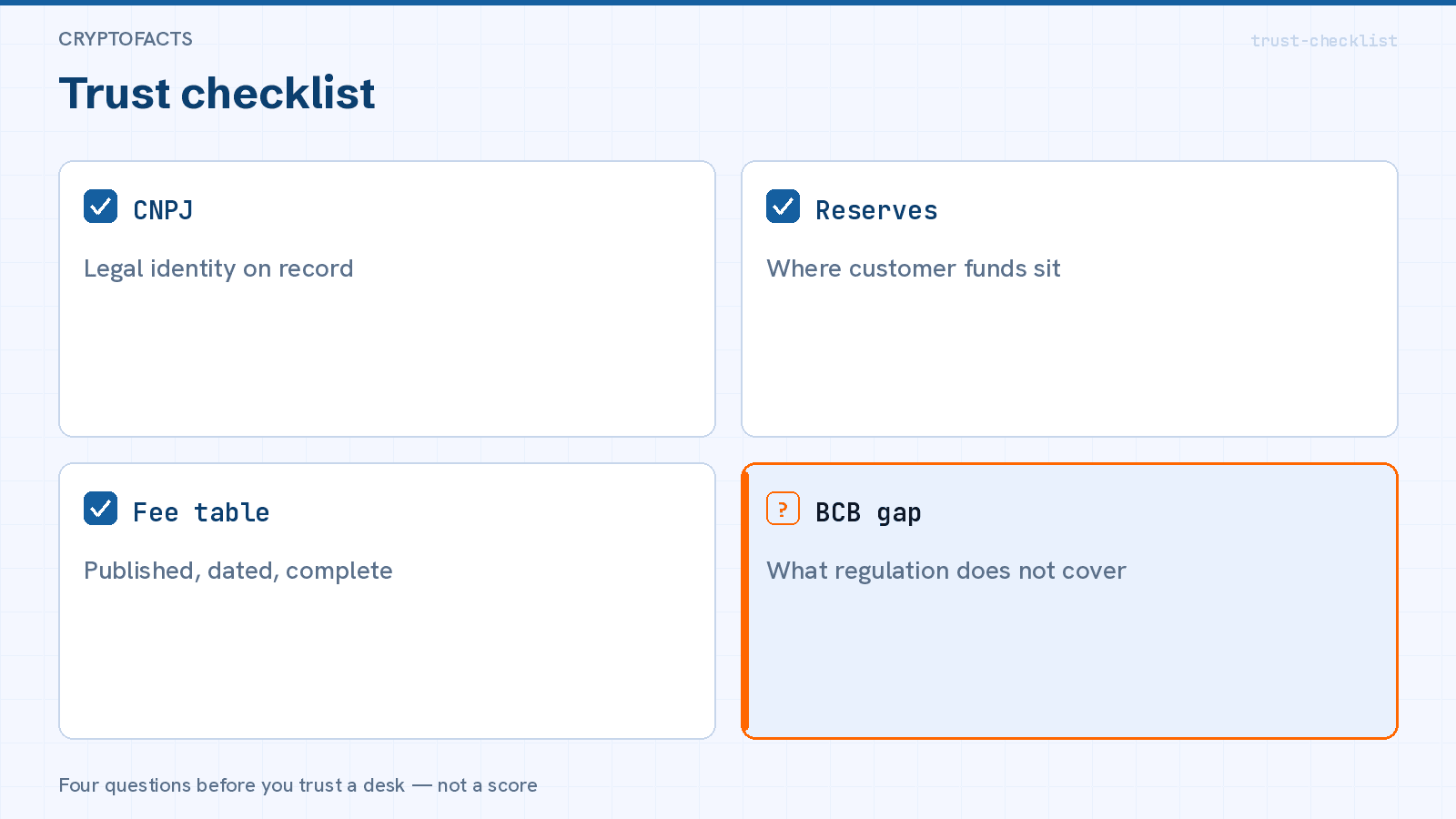
Brazil market statusandreason—editorial onlyblocks monetized CTAs until named authorisation evidence exists. - Separate spot fee from local rails (Pix, bank transfer) and from card products.
- If the field is null (Mercado Bitcoin fees), write “not verified” — do not paste a partner blog spreadsheet.
- Only then build the decision table. Vibes stay in the research queue, not in the evidence column.
Honest limits
We do not publish a secret comparison-UI weight equation here. If the exact weight of each dimension is undocumented, we say so. The vibes refusal still holds: missing public formula ≠ permission to use followers as a proxy.
BCB Resolution 520 frames the VASP transition context behind many editorial only labels. The label is not authorisation; it is also not automatic condemnation — it means “named entity not verified in this capture”.
FAQ
Why not rank on spot fee alone? Because 0.08% maker excludes Pix, withdrawals, card FX, and regulatory status. Spot is one slice.
Do vibes ever matter? They can open investigation. They never close a score.
Does Mercado Bitcoin “have no fees”? No. The profile has no verified like-for-like maker/taker — an explicit gap, not zero.
Does editorial only mean banned in Brazil? No. It means CryptoFacts compares editorially and does not enable signup CTAs until named authorisation evidence lands.
Can I use a VIP fee screenshot? Only if the profile’s fee basis note covers that tier. Otherwise you are mixing Non-VIP with an undeclared discount.
Verdict
Crypto facts vs vibes: the desk uses dated profiles. If we cannot cite the field (maker fee, fee basis note, Brazil market status), it does not enter the score — even if the group chat disagrees.