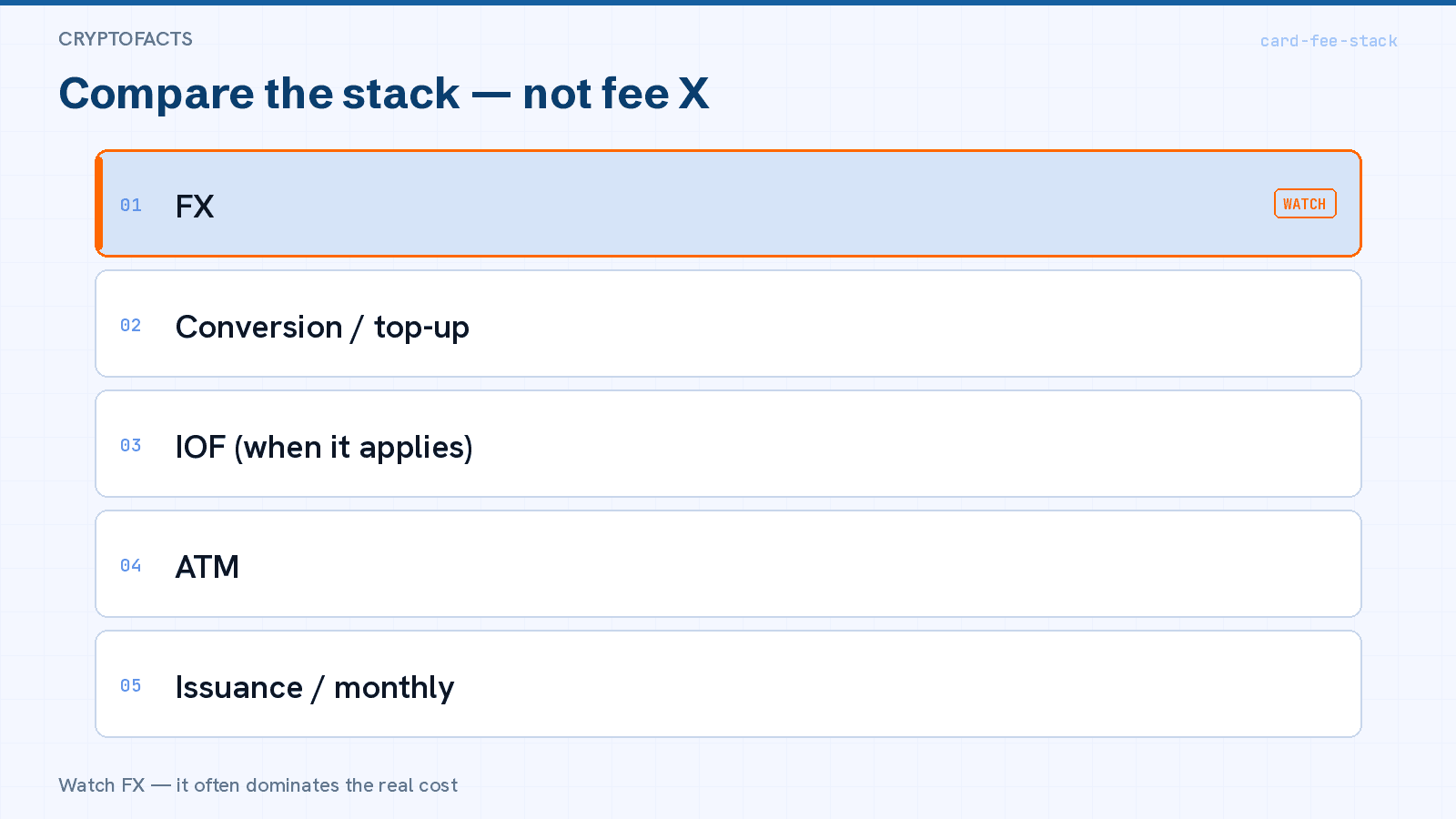
Stack order (matches the hero diagram): FX → conversion/top-up → IOF when it applies → ATM → issuance/monthly. Maker/taker trading fees are a different product.
Quick answer: The expensive surprise is not “fee X”. Compare the stack in order: FX → conversion/top-up → IOF (when it applies) → ATM → issuance/monthly, plus lines the profile does not publish. Figures: CryptoFacts provider profiles. Spread is unpublished on this set — we do not invent one.
| Factor | What the profile actually shows | Why one fee fails |
|---|---|---|
| FX | RedotPay 1.2%; Bybit Card 1.5%; OKX Card 0 in launch coverage; Binance Card BR unpublished | Ranking on monthly fees hides the largest spend percentage |
| Conversion / top-up | RedotPay +1% at spend; Bybit +0.9% top-up on top of One-Click Sell; OKX top-up 0 in coverage; Binance unpublished | Not the same field as FX |
| IOF | No universal desk rate; OKX launch coverage reports zero FX/IOF on purchases | Copying IOF across cards is a method error |
| ATM | Bybit: free to BRL 550/month then 2%; OKX ATM not available; RedotPay and Binance ATM available with no published % | Cash is not a purchase |
| Issuance / monthly | RedotPay issuance 10 USDT-eq., monthly 0; Bybit and Binance 0 and 0; OKX unpublished | Zero at the door does not zero the stack |
| Unpublished | Binance FX/conversion; OKX flat fees; ATM % for RedotPay/Binance | Empty field ≠ 0% |
| On-chain network | None of these profiles publish a network percentage | Crypto funding is a wallet line, outside the card schedule |
Do not compare fee X. Compare the stack.
Ads pick the clean number: monthly 0, cashback, “no annual fee”. The CryptoFacts profile stores the rest. Rank cards on one factor and Bybit Card and Binance Card BR tie at 0 issuance/monthly — a false tie. Bybit publishes 1.5% FX and 0.9% top-up. Binance Card BR leaves FX and conversion out of the BR profile on purpose (global-program figures were not carried over).
Three reading rules:
- Add the published lines (FX + conversion/top-up + ATM if you withdraw + issuance if this is the first card).
- Flag unpublished fields — that is comparison risk, not a discount.
- Treat IOF and network as factors outside the card schedule, checked on the actual operation, not as automatic zeros.
spread (unpublished) is null on all four profiles. What exists is FX fee. Do not stack an invented extra spread on top of published FX.
Factor 1 — FX (and what people call spread)
RedotPay: FX fee 1.2 on non-USD purchases, global USD (USDT-eq.) schedule. Bybit Card: FX fee 1.5, card settles in BRL. OKX Card: FX fee 0, with fee basis note citing Brazil launch coverage of zero FX spread/IOF on purchases. Binance Card BR: FX fee null.
The surprise: a Brazilian who spends in a currency that is not the card’s settlement currency still pays FX when the monthly fee is zero. On RedotPay, a non-USD purchase is the typical case if daily life is BRL. On Bybit Card, published FX is already 1.5% — higher than RedotPay’s 1.2% — and that still excludes top-up.
Do not use one card’s FX as another card’s proxy. Do not treat OKX Card’s reported 0% as “Brazil’s crypto-card market has no FX”.
Factor 2 — conversion at spend vs top-up
These are different lines. Profiles keep them apart.
- RedotPay: 1% crypto conversion at spend, on top of FX. Profile top-up / conversion fee is 0 — the 1% lives at spend, not at top-up. Looking only at top-up=0 misses the 1%.
- Bybit Card: top-up / conversion fee=0.9 is the crypto-conversion fee on top of the One-Click Sell rate, plus 1.5% FX. Two percentages, two moments (funding vs FX spend).
- OKX Card: top-up / conversion fee=0, aligned with launch coverage of zero BRL–stablecoin conversion. Confirm in-app.
- Binance Card BR: top-up / conversion fee=null. Same rule as FX: unpublished is not zero.
Published floor, using only profile percentages (no IOF, no ATM, no network):
- RedotPay on a non-USD purchase: 1.2% + 1% = 2.2% at spend, plus issuance 10 USDT-eq. if you have not paid it yet.
- Bybit Card: 1.5% FX + 0.9% top-up = 2.4% on published percentage lines, issuance 0.
- That is not total cost. It is the documented floor before factors the profile does not price.
Factor 3 — IOF, when the operation qualifies
IOF is not the FX fee field. This desk does not publish one IOF rate for crypto cards. The only ingested IOF statement in this set sits on OKX Card: launch coverage with zero FX/IOF on purchases. That does not authorise:
- copying 0% IOF onto RedotPay, Bybit Card, or Binance Card BR;
- substituting published FX with IOF;
- treating exchange Pix as “I already paid IOF, so the card is exempt”.
If card settlement is an international or FX operation under the rule, IOF may apply. If it is not, it may not. CryptoFacts does not close that bill on the profile. Read the operation receipt and, for a tax decision, talk to a professional. The surprise is methodological: IOF is a factor, not a slogan.
Factor 4 — ATM and cash
Purchases and withdrawals do not share a line.
- Bybit Card: ATM available. fee basis note: free tier to BRL 550/month, then 2%. The classic surprise is clearing the cap and finding 2% on the statement.
- OKX Card: ATM not available. Even with reported zero FX on purchases, cash is not part of the product on the profile. “No FX card” does not mean “free ATM card”.
- RedotPay and Binance Card BR: ATM available, ATM percentage unpublished. You can say cash-out exists as a capability; you cannot state the price.
If your job is ATM cash, the ATM factor can outweigh purchase FX. If your job is POS only, ATM should not pick the winner — but it still needs to be visible so it is not the travel surprise.
Factor 5 — issuance, monthly fees, and the “free” card
Bybit Card and Binance Card BR: issuance 0, monthly 0. RedotPay: issuance 10 (USDT-eq.), monthly 0. OKX Card: issuance and monthly unpublished.
Zero at the door is a useful activation fact. It is not a spend fact. Cashback also does not cancel FX: 2% back on top of 1.5% FX plus 0.9% top-up is not “the card pays you to swipe”. CryptoFacts does not store cashback as a fee field on these profiles, so this desk does not use cashback to zero the stack.
Factor 6 — unpublished is a factor, not a discount
Binance Card BR is the teaching case: Brazil schedule, flat fees in BRL, FX and conversion left out. Anyone comparing “Binance 0% FX” is reading a field that is not there. The honest comparison is: “FX not published — check in-app”.
OKX Card leaves flat fees unpublished for Brazil even with FX and top-up reported at zero. RedotPay and Binance do not publish the ATM %. spread (unpublished) is null on all four.
Desk rule: unpublished enters the checklist as a question, never as a zero in the spreadsheet.
Factor 7 — network and funding, outside the card schedule
None of the four profiles publish an on-chain network percentage. If you send USDT or another crypto to fund the card, network cost belongs to the wallet/network, not to the card schedule. Inventing a “network fee” and adding it to FX fee is the inverted form of ignoring FX.
What we can say: crypto funding is an extra step versus a bank card funded in BRL via Pix. Read that step where the transfer happens.
How the stack changes the ranking (no invented numbers)
Holding published fields only:
- RedotPay shows the most explicit non-USD spend stack (1.2% + 1%) and charges issuance 10 USDT-eq. Monthly 0. ATM with no published %.
- Bybit Card stacks 1.5% + 0.9% and documents ATM (BRL 550 / 2%). Issuance and monthly 0. Settles in BRL. BR status: editorial only.
- Binance Card BR wins the door slogan (0 and 0) and loses the FX comparison — the field is not there. ATM true, % unpublished. BR status: editorial only.
- OKX Card is the launch-coverage outlier (FX 0, top-up 0, IOF 0 on purchases) with ATM off and flat fees unpublished. BR status: editorial only. Confirm in-app before treating coverage as the live table.
None of the four “wins” if the question is fee X. The right question is: which factors does my use actually trigger (BRL spend, USD spend, cash-out, first card, on-chain funding)?
Checklist
- List the factors your use triggers: FX, conversion/top-up, IOF, ATM, issuance, network, unpublished.
- Add only what the profile publishes. Do not fill gaps with zero.
- Separate purchases from cash. Bybit Card ATM has a cap; OKX Card has no ATM on the profile.
- Do not compare cashback with FX. Different signals; cashback is not in these fee fields.
- Read Brazil market status. editorial only is not a CTA and not BCB authorisation.
- If the card is USD (RedotPay) and your spend is BRL, assume conversion-at-spend — the profile does not document native Pix.
R$ waterfall — R$1.000 foreign purchase (Bybit Card published lines)
Using only published Bybit Card figures (FX 1.5%, conversion 0.9%, issuance/monthly R$0; free ATM tier is irrelevant on a purchase):
- Conversion 0.9% → ≈ R$9.00
- FX 1.5% → ≈ R$15.00
- IOF → add only if your receipt shows it qualifies (not invented here)
- ATM → R$0 on a purchase
- Issuance/monthly → R$0
Subtotal before IOF ≈ R$24 on R$1.000. That is why ranking cards on “monthly fee = 0” misleads.
FAQ
Does a zero monthly fee remove IOF? No. Monthly fee and IOF are different factors. IOF depends on the operation.
Can I use the cashback table alone? No. Cashback does not cancel 1.2% or 1.5% FX, nor the 1% / 0.9% conversion lines.
What spread sits on top of FX? On these profiles, spread (unpublished) is unpublished. Use FX fee. Do not invent a second spread.
Does exchange Pix cover the card? Not automatically. Pix is a deposit rail; the card has its own schedule (global USD on RedotPay; BRL on Bybit Card).
If FX is unpublished, can I treat it as zero? No. That is the unpublished factor — ask in-app.
Is OKX Card with no ATM and no FX the cheapest? Only if your use is purchases and the launch coverage still matches the live product. No ATM, unpublished flat fees, and editorial only status still leave the comparison incomplete.
Verdict
The crypto card fees that surprise Brazilians do not fit in one fee X. They live in the stack: FX, conversion/top-up, IOF when it applies, ATM, issuance, unpublished lines, and network funding. Add what the profile publishes; flag what it does not; do not let a zero monthly-fee slogan close the bill.