Fees and terms are as captured on August 25, 2026, alongside our exchange data. Everything can change; confirm inside your own account.
Side by side
| Fact that changes the decision | Binance | Bybit |
|---|---|---|
| Published taker fee | 0.10% | 0.10% |
| Published maker fee | 0.10% | 0.10% |
| Scope of that schedule | global spot, before discounts | spot outside the VIP programme |
| Taker cost on BRL 1,000 | BRL 1.00 | BRL 1.00 |
| Provider warns your region changes the rate | yes, schedule not inherited locally | yes, stated on the fee page |
| Named Brazilian company in our data | not on record | Bybit Sociedade Prestadora de Serviços de Ativos Virtuais Ltda. |
| Proof of reserves with a captured source | yes, Merkle Tree | on record, public page not verified |
| Brazil market status | editorial only | editorial only |
Binance Global vs. 2 alternatives
A quick view of canonical data. Open the comparison for every source and condition.
 Binance Global
- Funding
- Not verified
- Taker fee
- 0.1%
- Status
- Editorial only
 Bitso
Bitso- Funding
- Pix + BRL
- Taker fee
- 0.4%
- Status
- Editorial only
 Coinbase
- Funding
- Pix + Bank transfer
- Taker fee
- 0.6%
- Status
- Editorial only
The headline price is a draw
Binance's fee schedule puts an ordinary account at level 0 with a maker and taker commission of 0.001, that is 0.10%. Bybit's trading fee structure splits users into Non-VIP and VIP, and the entry spot tier also sits at 0.10%.
On a BRL 1,000 taker buy that is BRL 1.00 either way. Picking on the headline number decides nothing here, which is exactly why the sentences printed next to the number matter more than the number. The full bill for each — Pix, withdrawals and pair traps — is in what Binance charges and what Bybit charges.
Both providers warn that this is not your rate
Bybit states outright that actual fee rates may vary depending on your region, and points users to their own fee-rate page after identity verification. On the Binance side, our data notes that the global spot schedule is a pre-discount figure and is not automatically inherited by local Binance entities.
In plain terms: both 0.10% figures are global reference prices, not quotes in reais for your account. The number that binds you is the one inside your verified account, and you only see it after opening and verifying both.
Once you hold both accounts, quote the same order in the same minute and compare the final amount in reais. That is the only cost comparison that means anything.
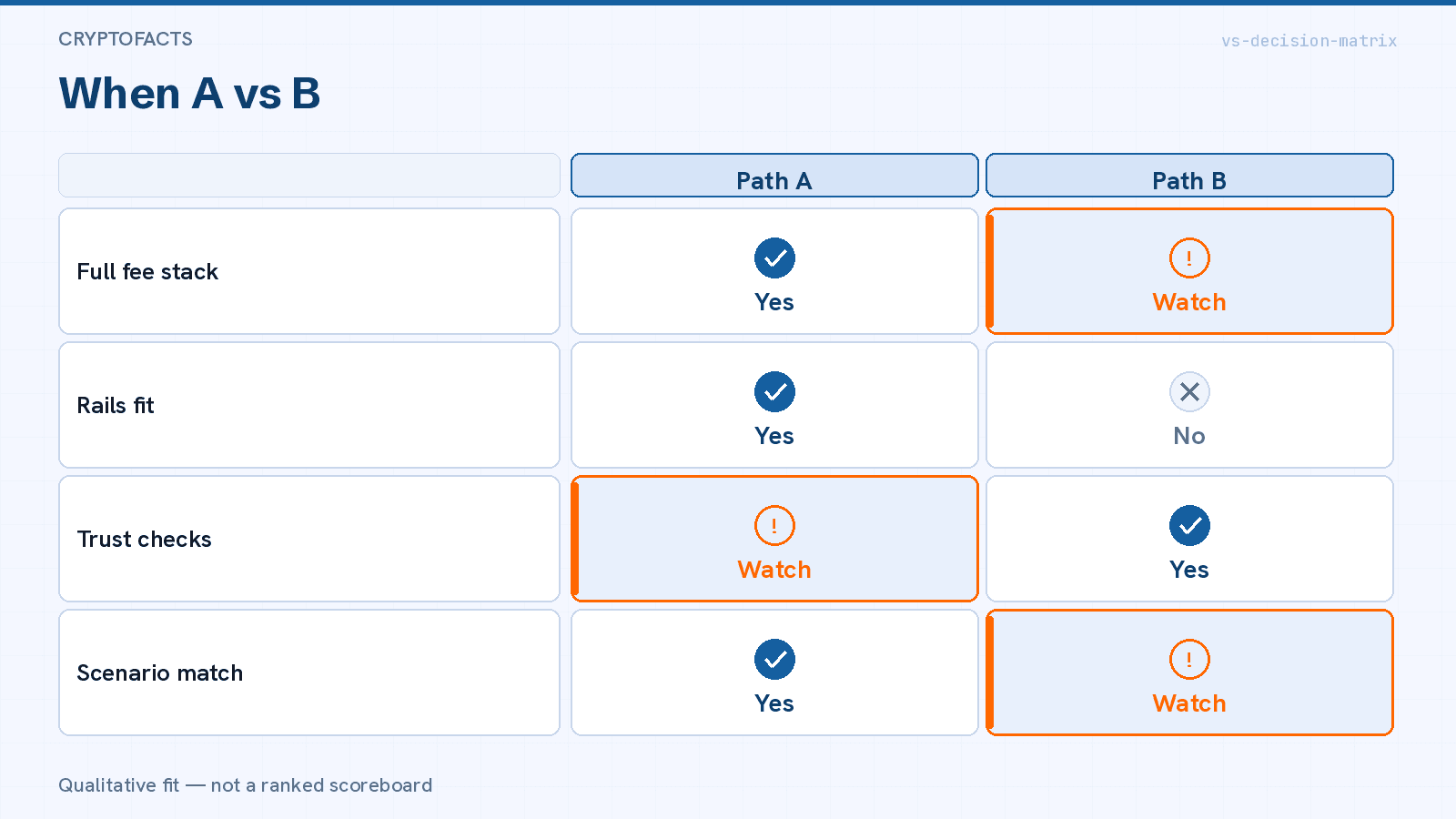
Which company you actually contract with
Here is the first real difference. In our data, Bybit has a named Brazilian entity, Bybit Sociedade Prestadora de Serviços de Ativos Virtuais Ltda., whose declared scope is Brazilian-real bank and QR-code fiat services. To be clear: this is not evidence of a Banco Central virtual-asset-service authorisation. It is a company incorporated in Brazil to handle reais, and nothing more than that.
What we have on Binance describes contracting entities that vary by region and names no Brazilian one. If knowing in advance who is responsible for your reais matters, this point goes to Bybit.
Availability: Brazil is not on the restriction list
Bybit's service-restricted countries article says the company does not offer services or products to users in a set of excluded jurisdictions, naming the United States, the Chinese Mainland, Hong Kong, Singapore and Canada among them. Brazil does not appear on that list.
Reserves: only one side has a captured proof
Binance's proof-of-reserves page says users can verify that all Binance account balances are fully backed 1:1, and that the company built and implemented a Merkle Tree so each user can confirm their own balance inside the aggregate.
Bybit also carries a proof-of-reserves programme in our data, but we did not verify its public page. If checking your own balance in a Merkle tree is something you will genuinely do, Binance is the only documented path here today.
Checklist before you open an account
- Verify identity, then open your own fee-rate page. That is your actual price.
- Confirm which company appears in the terms you accepted, and its registration number.
- Check how reais get in and out, with limits and timing, before your first deposit.
- If you use proof of reserves, generate your record and actually check the balance.
- Quote the same order on both at the same moment and compare the final amount.
- Decide how much of your money you are willing to leave with one custodian.
FAQ
Which one is cheaper? Neither, at the entry tier: both publish 0.10% on taker orders. Both also warn that the effective price depends on region, tier and discounts, so an honest comparison only happens inside two verified accounts.
Does a Brazilian company mean Bybit is licensed in Brazil? No. A company incorporated in Brazil to handle reais is not a Banco Central authorisation.
Can I open a Bybit account while living in Brazil? Brazil does not appear on the excluded-jurisdictions list Bybit publishes.
How do I fund Binance with reais? The sources behind this comparison describe no reais route for Binance, so confirm it in the app before relying on it. Our dedicated review, what Binance charges, covers what Binance publishes about BRL deposits and withdrawals.
Verdict
The headline price is a tie, so decide on everything else. Bybit if you want a named Brazilian company handling your reais; Binance if you want a public proof of reserves you can check today.
Both stay editorial only in our data because neither has a named Banco Central authorisation confirmed against an official source, which is why this page carries no referral link for either. See the alternatives in the exchange list and the cost ranking in which crypto exchange charges the lowest fees in Brazil.