| Fact | Implication |
|---|---|
| Binance spot 0.1%/0.1%; OKX 0.08%/0.1% | Only one corridor slice |
| Mercado Bitcoin: no like-for-like fee verified | Do not cite ungroomed third-party tables |
| Brazil status = editorial only on several globals | Monetized CTA blocked until evidence |
| Tax/IOF on remittance-like flows | Explicit unknown — no invented rate |
Fact vs narrative
Narrative: “USDT kills remittance cost.”
Fact: You still pay entry/exit rails, possible FX, compliance, and the spot leg. Published spot fee ≠ remittance TCO.
Narrative: “Just look at maker/taker.”
Fact: Binance Global 0.1%/0.1% and OKX Global 0.08%/0.1% describe spot trading on the profile — not the cost of putting BRL in, exiting another currency, or liquidating USDT off-ramp.
Narrative: “Mercado Bitcoin is cheapest in BRL.”
Fact: The profile carries no stable like-for-like maker/taker; fee basis note records the gap. Pix/bank_transfer exist as methods — that is rail friction, not an invented fee table.
On-ramp / off-ramp in Brazil
Read methods and market status from profiles:
- Mercado Bitcoin:
payment methods includes Pix and bank transfer;Brazil status = editorial only (no signup CTA)` in this capture (BCB transition without verified named authorisation). - Binance Global / OKX Global: published spot fees; empty `payment methods in this profile capture; Brazil status = editorial only. Do not invent native Pix because the brand is famous.
If the entry fee is missing on the profile, say “not verified”. Do not complete it from an affiliate blog.
Cost and speed vs traditional remittance
We can compare components:
- On-ramp (method + fee if published).
- Spot (maker/taker + fee basis note).
- Off-ramp / conversion (only if the profile or bound evidence carries the field).
- Settlement speed (separate from cost).
We do not close “USDT always cheaper than bank wires” without a dated full-corridor measurement. Settlement speed ≠ automatic savings.
BCB Resolution 520 frames VASP transition rules that affect how CryptoFacts labels Brazil availability — regulatory context for the corridor, not a remittance tax rate.
Binance Global vs. 2 alternatives
A quick view of canonical data. Open the comparison for every source and condition.
 Binance Global
- Funding
- Not verified
- Taker fee
- 0.1%
- Status
- Editorial only
 Bitso
Bitso- Funding
- Pix + BRL
- Taker fee
- 0.4%
- Status
- Editorial only
 Coinbase
- Funding
- Pix + Bank transfer
- Taker fee
- 0.6%
- Status
- Editorial only
Risks and unknowns
- Tax treatment of remittance-like flows (including IOF when it applies) — no invented rate.
- End-to-end USDT cost on a specific date.
- Blanket “no IOF” claims without profile support.
- Third-party tables for Mercado Bitcoin fees.
- Signup CTAs on
editorial onlyproviders.
Reader checklist
- Add on-ramp + spot + off-ramp before calling anything “cheap”.
- Check
Brazil market status—editorial onlyblocks monetized CTAs. - Separate settlement speed from total cost.
- Demand a dated source for any tax %.
- If maker/taker is null, write the gap (MB case).
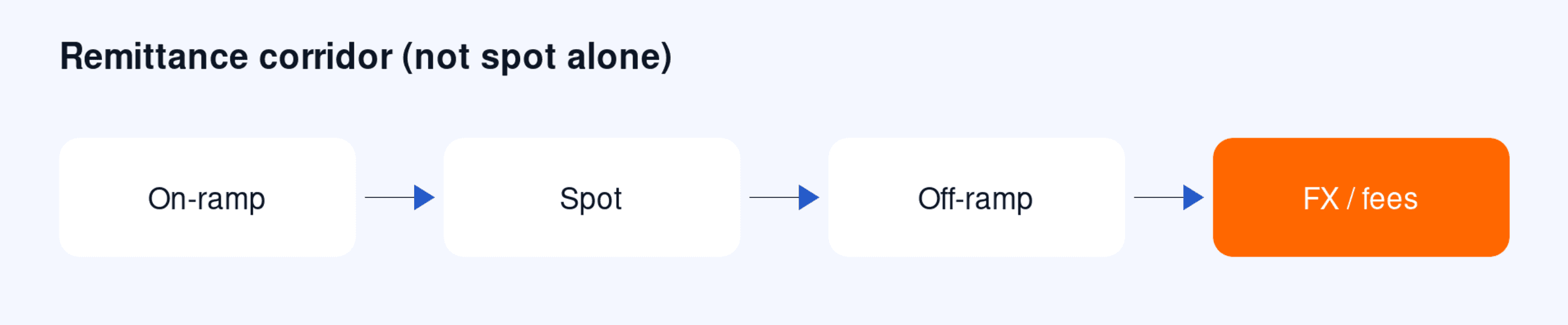
Corridor checklist (matches the hero diagram)
- On-ramp — how reais (or dollars) enter.
- Spot — maker/taker + the fee-basis note for the pair.
- Off-ramp — how value exits to the recipient rail.
- FX — any FX line on the last hop.
- Brazil status — editorial only vs open for signup CTAs in our dated capture.
FAQ
Do stablecoins avoid IOF? We do not claim that generally. It depends on the operation; the desk does not publish a universal rate here.
Which venue is cheapest for remittance? Depends on the corridor. Start from published fees (Binance 0.1%/0.1%; OKX 0.08%/0.1%) and gaps (MB without like-for-like fee).
Can I decide on spot fee alone? Not if the question is remittance. Spot is one line in the stack.
Does editorial only stop me from using the app? It is CryptoFacts’ label about authorisation evidence and CTAs — not a technical app block. Still do not read it as “BCB approved”.
Verdict
The stablecoin/remittance facts that matter in Brazil are corridor + evidence + explicit unknowns. Maker/taker helps; alone it does not close the case. Everything else is vibes.
Why the stack beats the slogan
Stablecoin remittance almost always crosses three mental products ads conflate: (1) BRL FX/entry, (2) the exchange spot book, (3) exit to a bank or spend rail. Each can carry different fees, delays, and compliance rules. That is why CryptoFacts refuses to close “USDT = cheap remittance” on a single maker/taker line.
Correct reading with the profiles in this capture:
- Use OKX 0.08%/0.1% or Binance 0.1%/0.1% only for the spot leg.
- Use Mercado Bitcoin to discuss Pix/
bank_transferrails — without inventing a fee percentage. - Keep IOF/tax as unknown until a dated source is bound in the pack.
Scenarios where the narrative breaks
- Cheap spot, expensive or unpublished on-ramp. Low maker does not save the bill.
- Fast settlement, slow off-ramp. Book speed ≠ money in the destination account.
editorial onlystatus. You can read the profile; you cannot push a CTA as if authorisation were verified.- Affiliate-blog tables for MB. If the profile marks a gap, the article marks a gap.
How the desk documents unknowns
Explicit unknowns are a feature, not an SEO failure. Allowed phrases: “not verified”, “null on the profile”, “no end-to-end measurement in this capture”. Forbidden: inventing a tax rate, copying an ungroomed spreadsheet, treating a Telegram vibe as corridor evidence.