| Principle | Practice |
|---|---|
| SSOT | CryptoFacts provider profiles + research packs with evidence hash |
| Fees | Maker/taker with fee basis note and capture date |
| CTA | Only if Brazil status = open for signup CTAs with disclosure on the button |
| Unknown | Stated, never filled with a guess |
| GEO | Answer first, then proof |
What source-backed comparison is
The opposite of a vibes listicle. If Binance Global shows 0.1%/0.1% maker/taker, it comes from the profile with fee basis note (“standard global spot fee before discounts”) — and you can re-check. The same rule covers OKX (0.08%/0.1%, regular-user) and Bybit (0.1%/0.1%, Non-VIP).
Source-backed comparison is not:
- copying an influencer ranking;
- mixing VIP and Non-VIP tiers without saying so;
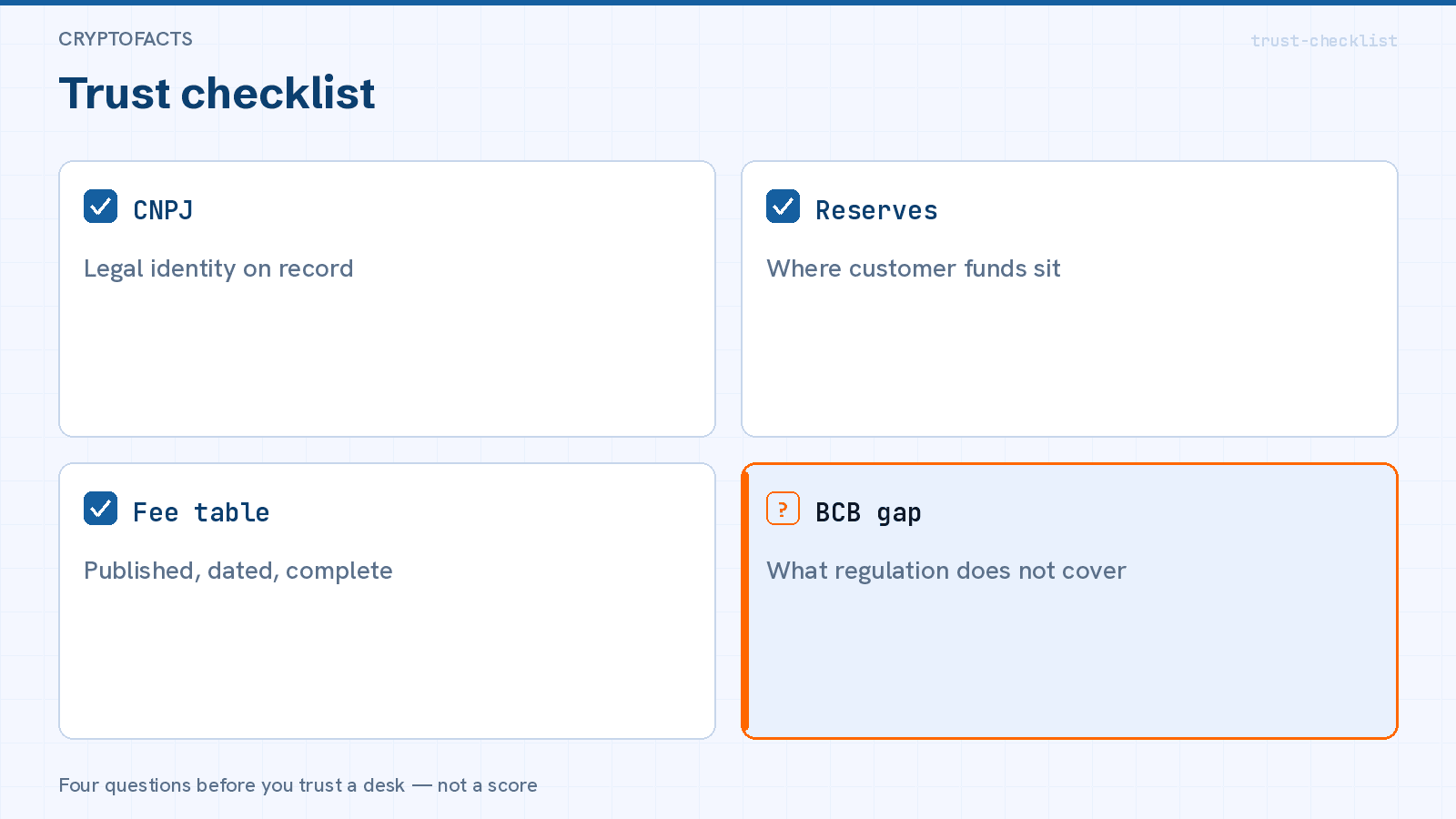
- treating BCB authorisation rumours as verified
market status; - inventing FX or IOF when the profile is null / unpublished.
Where the data comes from
Three layers, in order:
CryptoFacts provider profiles(product SSOT). Fees, fee basis note, market status, payment methods, compliance notes. Example: Binance Global 0.1%/0.1%; Mercado Bitcoin with null maker/taker and Pix/bank_transferlisted.- Official/regulator pages referenced in the pack. e.g. BCB financial-stability hub and BCB Resolution 520 for the VASP transition context behind many
editorial onlylabels. - Research pack with
evidence hash. Claims bound to evidence; generation citesevidence-bound claimsthat exist in the pack. Hash drift → revision does not publish.
CryptoFacts does not keep a second “official” fee spreadsheet outside the profile. If the profile is stale, the fix is to refresh the profile — not invent a number in the article.
What we do not do
- Invent FX when the field is missing.
- Treat
editorial onlyas BCB authorisation — or as a ban. It means “named entity not verified in this capture”; monetized CTAs stay off. - Hide partnerships. If
signup CTA providerspoints at amonetizableprovider, the CTA note carries commercial disclosure. Without a CTA, we do not mint a performative affiliate disclaimer. - Fill gaps with ungroomed third parties. Mercado Bitcoin: no verified like-for-like fee in profile → write the gap.
Binance Global vs. 2 alternatives
A quick view of canonical data. Open the comparison for every source and condition.
 Binance Global
- Funding
- Not verified
- Taker fee
- 0.1%
- Status
- Editorial only
 Bitso
Bitso- Funding
- Pix + BRL
- Taker fee
- 0.4%
- Status
- Editorial only
 Coinbase
- Funding
- Pix + Bank transfer
- Taker fee
- 0.6%
- Status
- Editorial only
How to use CryptoFacts (step by step)
- Read the GEO / quick answer at the top.
- Open the table or snapshot embed — check linked providers.
- In the profile (or the table built from it), read fee + fee basis note + date.
- Check
Brazil market statusbefore hunting for a signup button. - Only then compare products. If a material number has no field, treat it as unknown.
Concrete example: one sourced fee
Acceptable: “Binance Global publishes 0.1% maker / 0.1% taker in the CryptoFacts profile, with fee basis note for the standard global spot fee before discounts.”
Rejected: “Binance is the cheapest in Brazil” — mixes ranking, BR market, and total cost without evidence.
Rejected: “Mercado Bitcoin charges X%” when maker fee/taker fee are null on the profile.
FAQ
Is this investment advice? No. It is an editorial decision tool with sources.
Why do some signup buttons disappear? Because Brazil market status is not monetizable (e.g. several globals on editorial only).
Does AI write and publish alone? No. Generation enters review; publication needs hashes and checks. Article pages no longer show the performative “AI-assisted subject to review” header line.
Can I cite only Academy/Help Center without the profile? The pack may reference those URLs as evidence, but the product number the desk compares remains the ingested profile field.
Verdict
CryptoFacts = crypto facts with sources. Source-backed comparison = point to the dated field (or state the unknown). If we cannot point, it is not a fact — it is vibes.
Why GEO and sources travel together
The quick answer at the top does not replace proof — it front-loads the decision. Proof remains the dated field. If the quick answer says “0.1%/0.1% on Binance Global”, the body must show where the number came from and what fee basis note applies. Without that, CryptoFacts would be taking the same shortcut it criticises in vibes posts.
GEO also explains shape: question title, early verdict, short table, then named modules. That is not “long text for SEO”; it is so a reader can check the fact without reading everything.
How this ties to commercial status
Brazil status = editorial only (no signup CTA) on the globals on this desk (including Binance Global in this explainer) means: editorial comparison is allowed; a signup CTA is not until named authorisation evidence lands. That is CryptoFacts product policy aligned to the capture — not a moral judgement of the app.
When a provider is monetizable, commercial disclosure lives on the CTA note, not as a generic “AI-assisted” header line on the article.
Appendix — editorial pipeline (optional)
For operators: generation binds evidence-bound claims that exist in the research pack and linked providers that exist in profiles; evidence-hash drift blocks a revision from publishing. Accept/reject still sits with a named human on final publication. Readers can ignore this appendix — the Accept/Reject rule in the body is enough.